

 LinkedIn

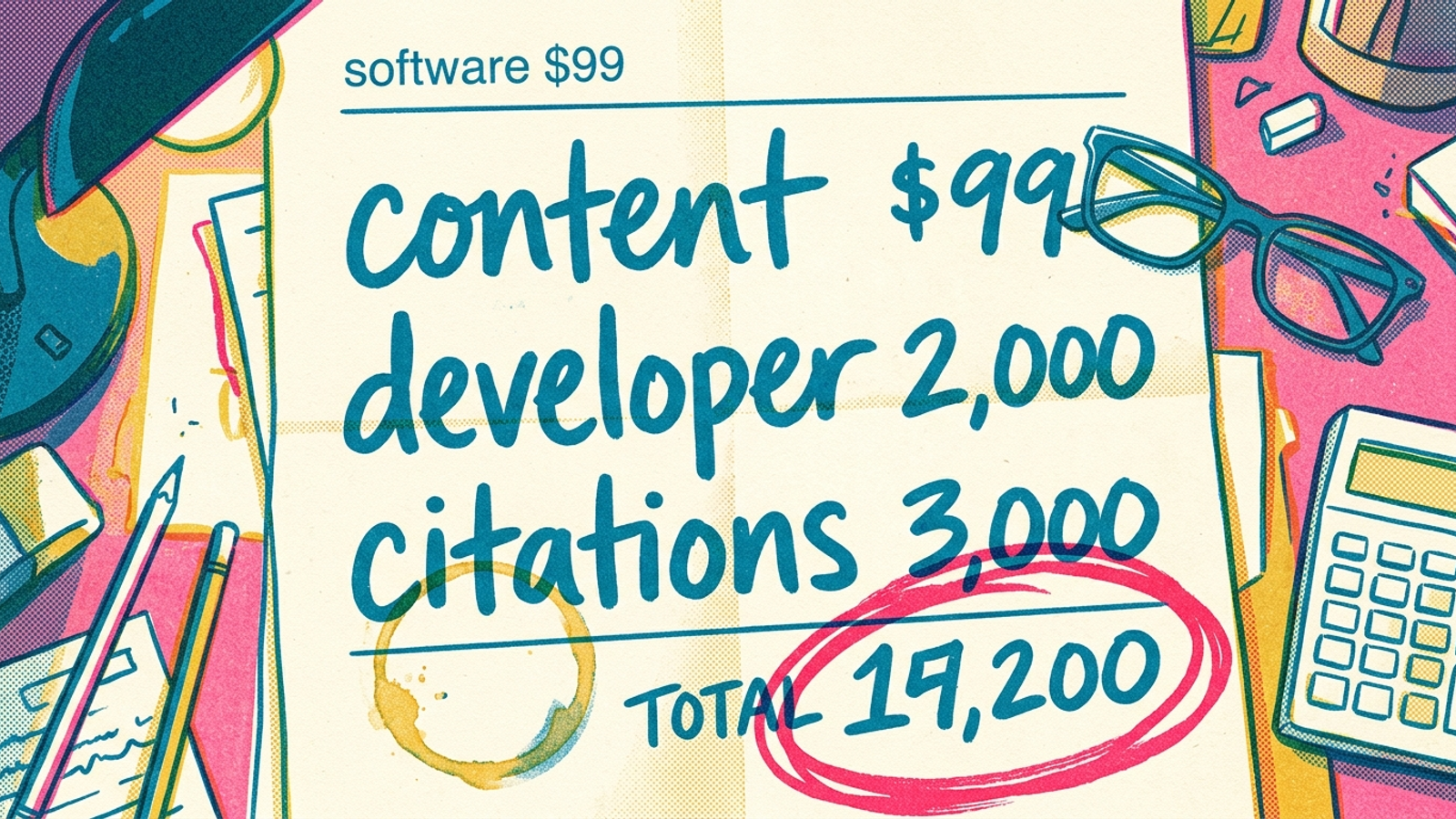
A $99 tracker does not deliver a $99 AEO service. For one client domain with 40 tracked prompts, four pages touched and two quality citations in the monthly scope, the line items below add up to roughly $4,900 to $7,600 before margin, shared software overhead or one-off setup. The subscription is the small line. Execution eats the retainer.
I used to tell clients the software did the work. I was wrong. Someone still has to find the missing answers, write and publish the pages, fix what crawlers cannot use, pursue citations and explain the result. If an agency prices the seat but not those hours, it has not priced delivery.
One domain, one month: what this budget buys
Here is the model I am costing: a 100-page services or B2B SaaS site on WordPress or a similar CMS, with messy schema and no ongoing digital PR. Each month, the agency checks 40 buyer prompts weekly across ChatGPT, Perplexity, Gemini and Google AI Overviews; produces two new pages; refreshes two more; handles the associated technical and publishing work; budgets for two quality citations; and sends a client report.
The working assumptions matter more than the neat total:
- Two new pages run about 1,500 words each. The two refreshes take about four hours apiece.
- Freelance drafts cost 25 to 45 cents per word. The model adds $45 to $75 in copyediting per new page and $65 to $100 an hour for refresh work.
- Analyst time runs $75 to $100 an hour, developer time $125 to $175, and account management $75. These are budget assumptions for this example, not a universal rate card.
- Edge setup is a one-off job. Ordinary delivery repeats monthly. Shared subscriptions need an allocation rule rather than being charged in full to every client.
A different site or scope changes the bill. That is a reason to show the drivers, not to hide them inside a package price.
The monthly bill: labor, citations, then software
| Line item | Monthly volume and cost for one domain | Basis for the figure |
|---|---|---|
| Prompt tracking | 40 prompts weekly across four engines; budget $99–$399 for monitoring, subject to plan limits | Listed monitoring prices and caps; the $99 tier is capped at 25 prompts, so it does not cover this model as stated |
| Answer mapping | 3–5 analyst hours; $225–$500 | Model hours at $75–$100/hour |
| Two new pages | 3,000 words plus two copyedits; $840–$1,500 | Freelance per-word range plus the model’s editing allowance |
| Two refreshes | About 8 hours; $520–$800 | Model hours at $65–$100/hour |
| Schema, crawlability and rendering fixes | 2–4 hours; $200–$600 | Model technical-work allowance; the work required varies by site |
| CMS publishing | 1–2 hours; $65–$200 | Model hours at $65–$100/hour |
| Citation work | Budget for two quality links or mentions; $2,500–$3,000 | Two at the $1,250–$1,500 per-quality-link range; a budget is not a guarantee of placement |
| Reporting | 2–3 hours; $150–$225 | Model hours at $75/hour; shared reporting tools are separate |
| QA and revisions | About 2 hours; $150–$200 | Model hours at $75–$100/hour |
| Account management | About 2 hours; $150 | Model hours at $75/hour |
That puts the stated monthly line items at approximately $4,900–$7,600. The low end is generous to the buyer: the cited $99 monitoring tier caps out below 40 prompts. It is in the table so you can see where the attractive entry price stops applying, not because I think it buys the whole monitoring scope.
The total also assumes the citation budget belongs to this client. Remove that work and the bill falls. Promise it without funding it and the agency, not the spreadsheet, absorbs the difference. Mid-market done-for-you retainers are benchmarked at $2,000–$8,000 a month, while a specialist-agency benchmark sits at $10,000–$18,000. Those are selling prices, not proof that every scope fits profitably inside them.
The monitoring cap arrives before the first report
Forty prompts checked weekly across four engines comes to about 640 answer pulls in a four-week month. That is useful coverage, but a 25-prompt entry cap is already too small. Expanding the set as the client finds new competitors or questions can push monitoring spend up again. The cited agency-tool comparison puts a Geoptie Enterprise plan at $399 a month and a larger Profound setup at $4,089 for ten clients; it also lists a $399 client-workspace charge for Profound.
The point is not to pretend those products have identical scopes. It is to read the meter before quoting a fixed retainer. Price the prompt allowance you intend to use, with room for the set to grow.
Mapping decides which pages earn their cost
A tracker can show that the client was absent from an answer. It cannot decide what the agency should make next. Someone needs to review the answers, note which sources appear and sort the misses: no relevant page, a relevant page that was not quoted, or a page losing ground to another source. I allow three to five analyst hours for that work, or $225–$500.
Without that sheet, writers guess. With it, the two new pages have missing answers to address and the two refreshes have a reason to exist. Do not cut mapping to make an otherwise uneconomic content quote look tidy.
Content is the steady labor bill
Two 1,500-word drafts at 25 to 45 cents a word cost $750–$1,350. Add two copyedits at $45–$75 each and the new-page line becomes $840–$1,500. Two four-hour refreshes add $520–$800. If a piece needs interviews or original data, the draft’s specialist range is $800–$2,500 for that piece instead.
I used to tell clients one good page a month was enough. I was wrong about treating that as a default. In this model, four touches are the agreed delivery volume; the answer map tells us what deserves them. Quote pages touched and work required, not a pile of words that may never get published.
Technical fixes and publishing are two different jobs
On this model domain, allow two to four hours for schema, crawlability and rendering fixes: $200–$600. That may mean repairing markup on the touched pages, checking that the pages can be fetched and testing the result. The site determines the actual list. Calling the work a “technical optimization” does not make the CMS or its quirks disappear.
Then someone must publish. Formatting, internal links, images and a final live-page check take another one to two hours here, $65–$200. A finished draft in Google Docs is not a live page. If the client owns publishing, put that handoff and its likely delay in the scope rather than quietly counting the page as shipped.
Citations are the spike that breaks a cheap quote
Two quality placements are the largest single allowance in this table: $2,500–$3,000 at the cited $1,250–$1,500 per-link range. The same source puts typical digital PR campaigns at $5,000–$10,000 for six to seven linking root domains. That is why “we will handle authority” needs a budget and a definition of what the agency is pursuing.
The cheap-looking substitute is not automatically equivalent. The cited pricing analysis puts vendor guest posts at an average $461, with only 1.37% meeting its quality bar. I would not base a client promise on a low unit price and hope quality takes care of itself. State whether citations are included, pursued or excluded. Those are three different quotes.

Reporting and QA consume hours even when they create no page
The client needs more than a screenshot of 40 tracked prompts. In this model, turning the checks into a readable report takes two to three hours, $150–$225. QA and revisions take another two hours, $150–$200. Account management takes two more, $150. Those hours do not produce a citation. They do produce a service a client can inspect and discuss.
Keep shared tools in a separate column of the agency budget. A small-shop stack is estimated at $150–$350 a month; higher tiers cited for API and white-label needs are $499.95 a month for Semrush Business and $449 for Ahrefs Advanced. Do not add every subscription in full to every domain. Allocate what the agency actually uses across the clients using it.
The separate bill: edge setup and other first-month friction
Edge-proxy or tag setup is not a recurring content task. If this client needs it, the model allows three to six developer hours for routing, testing and a rollback plan: $375–$1,050 one-off at $125–$175 an hour. It may then need about an hour of developer attention in a month when an update breaks something.
That is the developer line a polished vendor deck can make look like a toggle. It is not a reason to charge setup every month, and it is not a reason to pretend the first month costs the same as the second. Get access and an approver before promising a launch date.
Three ways to pay for the same scope
The work does not vanish when its invoice changes shape. Here are the delivery choices, using the monthly scope above and keeping edge setup separate.
-
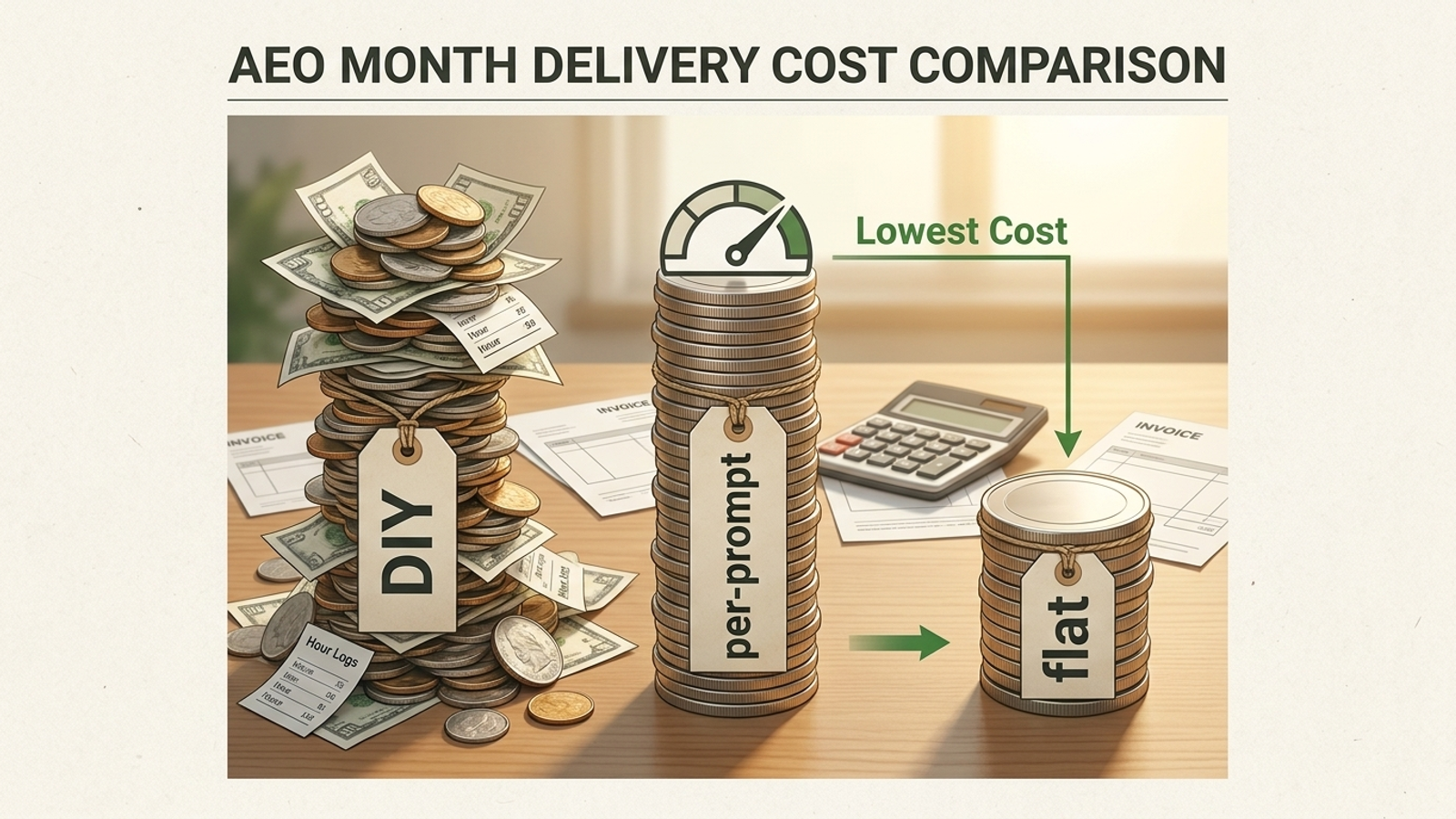
A monitoring tool plus the agency team. The agency buys tracking and staffs mapping, content, technical work, publishing, citations, reporting and client management. The modeled recurring line items total about $4,900–$7,600 per domain, before an allocation for shared tools. The agency controls every edit and carries every hour. At five domains, that is five sets of pages, reviews and citation budgets; a cheaper tracker does not do the work for them. It is the same hire-or-buy pressure agencies face when scaling paid-search execution.
-
A higher-priced, per-prompt platform plus the agency team. Better coverage may justify the monitoring bill, but it does not remove the writer, developer or outreach scope. If monitoring for this model costs $399–$800 instead of the $99–$399 allowance, the other listed work brings the illustrative monthly total to roughly $5,200–$8,000, before shared overhead. Check the cap and the deliverables separately. I have made the same argument about prompt caps: paying more to observe a gap is not the same as paying someone to fix it.
-
A flat per-domain execution platform. groas describes its agency offer as per-domain SEO and AI-search execution that includes content, technical fixes and citations, with weekly tracking under the agency’s brand. That is a more useful comparison for an agency buying delivery, because those are the expensive lines above. The agency still needs to check the agreed scope, including publishing responsibilities and any site-specific edge work, before removing a line from its own budget.
For a clean illustration, suppose that last option is quoted at $999 per domain per month for the modeled scope. That is an assumption for the comparison, not a published groas price. Add two to three hours of agency review and client-facing time at $75 an hour, and the example costs $1,149–$1,224 monthly, before shared overhead or any work outside the platform agreement. The question for an agency is not whether $999 looks nicer on a slide. It is which delivery jobs the fee actually replaces. That is also the test behind comparing AEO software at client number ten.
Margin at one, five and ten domains
Use the same $3,500 monthly retainer for each client and the same scope. This is contribution after the modeled delivery costs, not company-wide profit: it excludes shared overhead, sales expense and one-off setup.
| Domains | Monthly retainer revenue | Agency-staffed delivery at ~$4,900–$7,600 per domain | Illustrative flat execution at $999, plus 2–3 review hours per domain |
|---|---|---|---|
| 1 | $3,500 | About $1,400–$4,100 short | About $2,276–$2,351 left |
| 5 | $17,500 | About $7,000–$20,500 short | About $11,380–$11,755 left |
| 10 | $35,000 | About $14,000–$41,000 short | About $22,760–$23,510 left |
Multiplying one-domain costs does not model hiring efficiencies, discounts or a real platform quote. It does expose the problem with selling an unchanged, citation-heavy scope for $3,500: volume multiplies a bad unit margin. A staffing plan might lower the per-domain cost; a reduced scope might make that retainer viable. Neither happens just because the agency signs client five.
When I would keep delivery in-house
I would skip the platform comparison if the agency already has a writer producing 12 to 20 pieces a month, a developer who can ship site changes promptly and a PR lead earning the mentions in the scope. Existing staff and an established process can change the cost per domain. I would also keep the work in-house if clients specifically buy the agency’s byline, data studies or newsroom relationships. In that case, outsourcing execution removes part of the product.
For everyone else, “we have freelancers” is not a cost model. Put their hours, the citation allowance, publishing ownership and client time on the sheet before calling the spread between fee and tracker price a margin.
The cheapest mistake and the most expensive one
The cheapest mistake is cutting the $225–$500 answer-mapping step. It saves a few hours, then leaves writers choosing two new pages without knowing which missing answers they should address. Paying for the drafts does not repair that decision.
The most expensive mistake is signing a fixed $3,500 retainer against a $4,900–$7,600 monthly delivery plan and assuming software will close the gap. It will not. Price the pages, technical work, publishing, citations and client time first. Put one-off developer work on its own line. Put the software last. Then choose the delivery model that still pays you when the work actually ships.