

 LinkedIn

Our edge logs recorded 480 ChatGPT-User fetches of one analysis page in 30 days. That is not 480 citations. It is a useful clue about why ChatGPT might cite your competitor instead of you: a citation is decided when an assistant retrieves material for a particular answer, not awarded as a position you hold indefinitely.
The page covered recent ad platform changes. It was not sitting in Google’s top three for the relevant searches, had no paid backlinks pointed at it, and had not been run through specialized generative engine optimization software. Yet it kept getting fetched. As I argued in our 30-day edge log teardown, that observation is more useful than another screenshot of an AI answer. The server can show the retrieval event; the screenshot shows only its possible result.
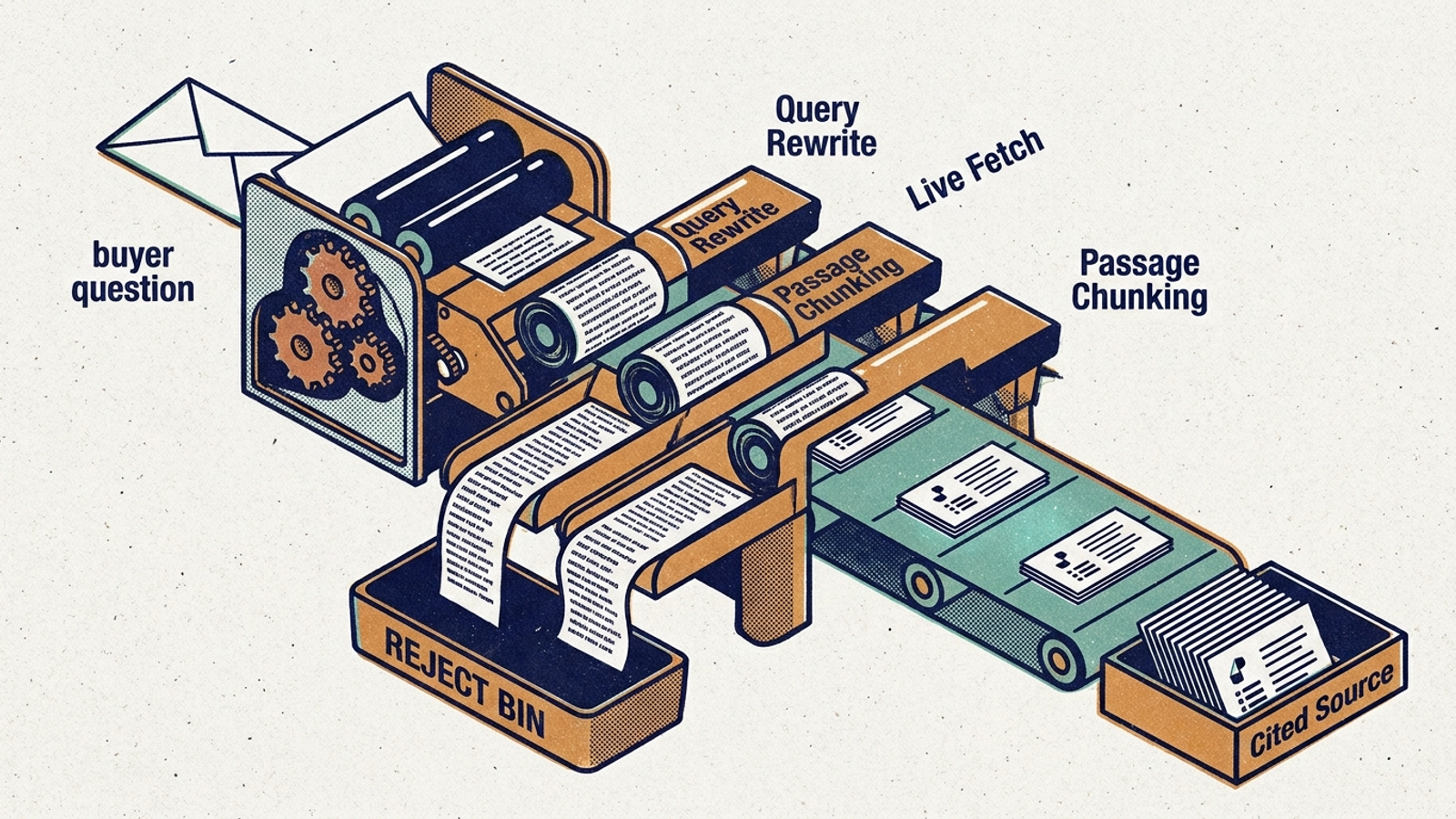
Picture a buyer asking an assistant what changed on an ad platform and whether it affects a vendor they are considering. Your page and a competitor’s page both cover the update. The assistant may search, fetch candidate pages, and pull out passages that answer the question. The competitor does not need a permanent place above you in an AI results list. They need to be the better source for that question, at that moment. Let’s follow the buyer’s question through the machinery.
First, separate what the model remembers from what it fetches
A language model can answer from parametric memory: information represented in the weights it acquired during training. It can also use live retrieval: an on-demand search or fetch that brings outside material into the context for an answer. Those are different routes. A link to a newly published page depends on the second one.
Training memory cannot keep up with this buyer’s question
Suppose your page explains an ad platform change published today. You can write the clearest explanation in your category, but you cannot put it into a model’s existing weights this afternoon. Training runs happen on their own schedules. They also compress information rather than preserving every product name, price, and technical detail as a reliable record.
That is why I would not frame the job as “teaching the AI our brand.” It encourages a team to publish a large guide and wait for some imagined moment of absorption. If the buyer needs a current answer, the immediate question is simpler: can the assistant find and read the right page now?
Live retrieval creates the opportunity to be cited
Onely’s search analysis estimates that ChatGPT uses live web retrieval on roughly 34.5% of queries. The route matters most when a question calls for fresh facts, technical details, or a comparison. Not every answer takes that route, and a fetch does not guarantee a citation. But when an assistant searches the web, your published page has a chance to contribute to that answer without waiting for another training run.
The bot names help keep the distinction straight. OpenAI documents separate roles: GPTBot collects material for model training, OAI-SearchBot supports search features, and ChatGPT-User can fetch a page in response to a user request. A visit from one is not interchangeable with a visit from another. For a fuller treatment of getting cited in ChatGPT and Perplexity, start with that distinction. It determines which problem you are trying to solve.
Next, the assistant has to find a candidate page
Return to our buyer. They ask a conversational question about the platform change, perhaps with a vendor comparison folded into it. A search-enabled assistant can break that request into narrower searches rather than looking up the entire sentence as written. Technical teardowns of ChatGPT Search describe this query-formulation step.
That changes what “ranking for the question” means. Your team may check one Google query that sounds like the buyer’s prompt and find your page in a satisfying position. The assistant may use different terms and look for different pieces of the answer. An observational study of ChatGPT web search found that Google results recovered only roughly a quarter of the exact URLs ChatGPT cited in the queries it examined. Its analysis also associated appearing across multiple rewritten searches with a greater likelihood of citation.
Those findings do not give you a secret list of prompts to stuff into headings. They give you a better test: does the page answer the smaller questions inside the buyer’s request? Our analysis page, for instance, has to make the relevant change and its implications easy to identify. A competitor’s broad industry guide may attract more ordinary search traffic yet be less useful for that narrower task.
Then the fetch has to work
A candidate URL is not useful if the assistant cannot retrieve the content it needs. Live requests may appear in logs under user agents such as ChatGPT-User, Claude-User, or Perplexity-User. Those are different from background training crawlers. As Veritas’s analysis of Perplexity discusses, fetching material for an active question puts practical pressure on access and speed.
If your page returns a verification screen, a forbidden response, or HTML that contains little of the actual answer, you have made the competitor’s job easier. The assistant cannot quote a specification it never receives. A slow response can also make a page less useful in a time-sensitive retrieval process, though there is no universal millisecond cutoff that makes every page win or lose.
Our 480 requests establish that this particular page was fetched repeatedly. They do not, by themselves, establish which buyer questions caused the fetches or whether every resulting answer linked to us. That distinction matters when you read your own logs. A fetch is evidence of access, not proof of a citation.
Finally, a passage has to answer cleanly
Once content is available, an assistant still needs material it can use. Retrieval systems can evaluate portions of a page rather than treating a long article as one indivisible answer. WitsCode’s retrieval analysis describes how passage quality affects whether relevant material is found.
Imagine our page and the competitor’s both contain the two figures the buyer needs. On our page, the figures sit beside a direct explanation of what changed. On theirs, one appears in an introductory story and the other is buried under an unrelated heading. Their page may be longer and more comprehensive. Ours gives a retrieval system a cleaner passage to use.
This is not an argument for making every article 60 words long. It is an argument for placing a self-contained answer where a reader, or a retrieval system, can recognize it without reconstructing the point from four sections. The surrounding analysis still has a job: explain why the figures matter.
The paid-search analogy works, until it doesn’t
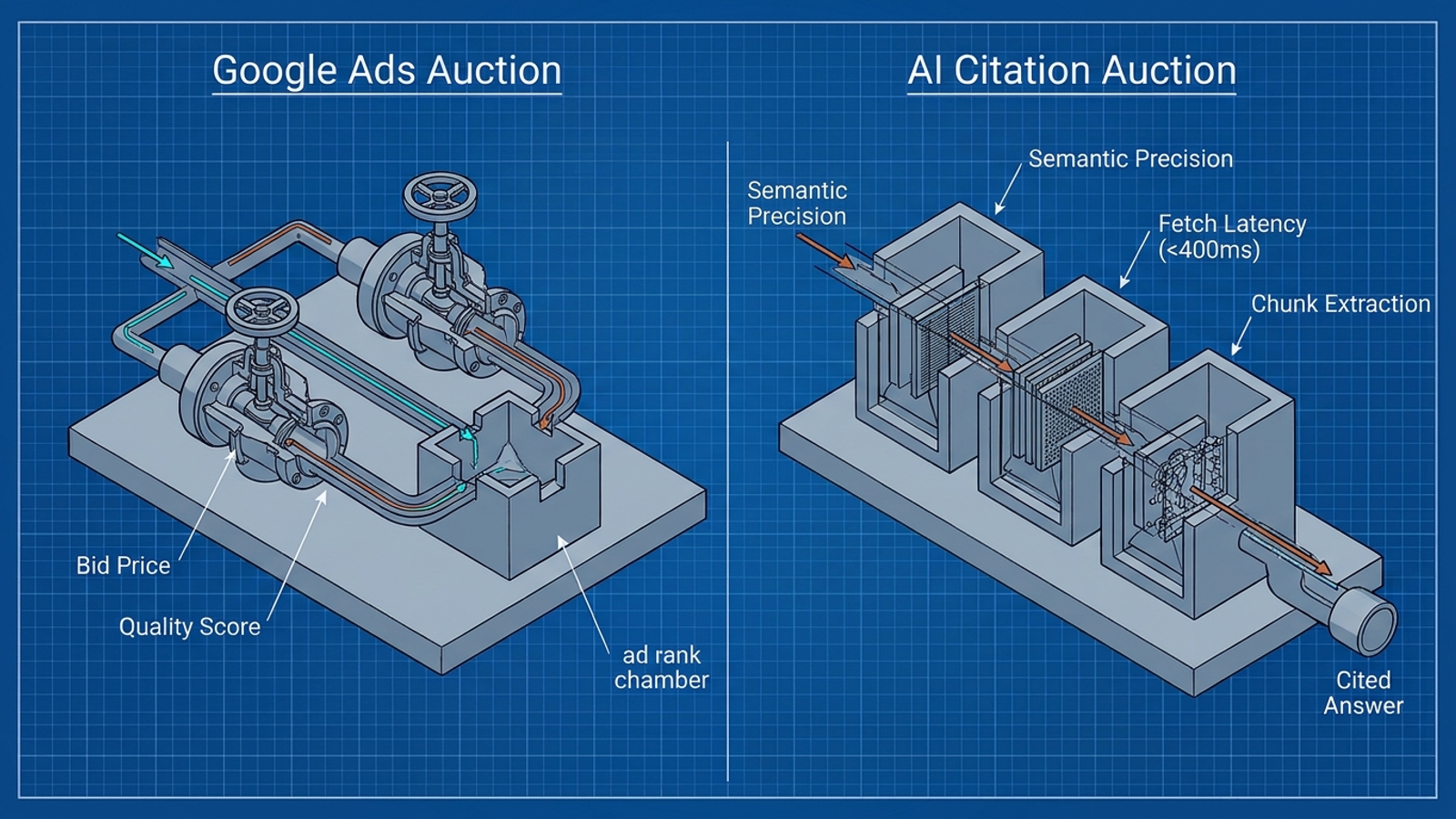
I spent years explaining to clients that a Google Ads position is not a trophy you put on a shelf. An ad competes again for each eligible query. Bid, relevance, and landing page experience affect whether it shows and where. A page eligible to be cited faces a similarly recurring test: for this question, can the assistant find it, access it, and use its answer?
That is the useful part of the analogy. A citation is per question, not permanently owned. It explains why a competitor can appear for one formulation while you appear for another. It also explains why a technically inaccessible page cannot coast on yesterday’s strong showing.
The analogy breaks at the word auction. There is no advertiser bid for an ordinary AI citation and no published citation equivalent of Google Ads’ Quality Score. The assistant is selecting sources under its own retrieval and answer-generation constraints, not selling a slot. Treat “citation auction” as a way to reason about repeated competition, not as a claim that the two systems share a scoring formula.
Three inputs are worth examining in that recurring selection:
- Relevance: Does a passage directly answer a part of the buyer’s question? The Generative Engine Optimization study found gains in visibility from approaches including concrete statistics and quotations. That is a reason to make useful evidence easy to locate, not a license to pack a page with numbers.
- Accessibility: Can the fetcher reach the content, and does the returned page contain the text? The practical checks in our AI crawler swipe file start here. A polished interactive page does little for retrieval if its important answer is absent from the response a bot receives.
- Corroboration: Can a claim be understood alongside other available information? When you make a product or benchmark claim, clear specifications and independent discussion help a reader evaluate it too. Do not confuse repeating your own claim across five pages with five independent sources.
Notice the order. I check whether the answer exists and can be fetched before worrying about how widely the brand is discussed. If the assistant cannot read the page, authority is not the first repair.
A missing citation may be a broken retrieval chain
Teams often begin with the copy: more keywords, a longer introduction, another “ultimate guide.” I begin one step earlier. What does the server return when a live fetcher requests the page?
A blocked request can return 403 Forbidden. A defensive rule can send it to an access-denied page. A client-rendered page can deliver an HTML shell while the pricing table or technical explanation arrives later through JavaScript. Those are not problems a stronger headline can solve. They interrupt the chain before passage selection begins.
Once the page is readable, architecture matters. A long guide is not inherently bad; I have written plenty. But length does not rescue a point scattered across an introduction, a table, and a closing caveat. For our running example, put the platform change, the relevant figures, and their meaning together. Give that passage a heading that says what question it answers. Then let the rest of the article develop the consequences.
The practical distinction is access first, answer placement second. Reversing it can leave a team polishing a passage the assistant never sees.
Check whether those bot visits are real
Access logs introduce another trap. A request that declares itself ChatGPT-User is not necessarily from OpenAI. User-agent strings can be spoofed. The AI bot verification study describes checking claimed crawler traffic against published IP information and reverse DNS rather than trusting the label alone.
That changes how I would read the 480-fetch example. Start with the requests. Verify the origin before attributing them to a platform. Then examine the requested URLs, responses, and timing. Do not turn a count of fetches into a count of buyer-visible citations; the edge log does not show the finished answer.
Measure the event you can observe. A verified fetch tells you the page was requested. To judge citation visibility, you also need to inspect the answers buyers actually receive.
Apply the model before buying another AEO dashboard
If your competitor keeps getting the link, work through the buyer’s question in retrieval order. I would do this before paying for another report of prompts where the brand is absent:
- Check access. Inspect firewall and WAF logs for legitimate live fetchers, using published verification information rather than trusting a user-agent string. Confirm that important public pages return usable content rather than a block or interactive challenge.
- Read the returned HTML. Request a critical URL with a relevant user agent, then inspect the response. A
curl -A "ChatGPT-User" [your-url]check can expose an empty HTML shell. Make sure the specification, comparison, or pricing explanation you want used is present in the content returned. - Check the passage. On the page most relevant to the buyer’s question, place a direct answer beneath a descriptive heading. Keep the figures and explanation together. Cut the preamble that delays them.
- Check the claim outside your site. If the answer relies on a product specification or benchmark, ask whether there is independent material that helps substantiate it. Do not manufacture corroboration by republishing the same assertion elsewhere.
- Check the answer, not just the visits. Test the buyer’s question and inspect what the assistant cites. A successful fetch and a useful passage improve your chance; neither promises the link.
Now try a new case with the same model. A buyer asks for a comparison involving a product whose pricing has just changed. Your old guide ranks well, but its pricing explanation loads through a client-side component. A competitor publishes a plain page with a current, self-contained comparison. Training memory cannot reliably settle a recent change. If the assistant retrieves pages, your guide may be found but fail to supply the needed passage, while the competitor’s page can. The first fix is not a bigger guide or a backlink campaign. It is making your current explanation retrievable, then making it clear.
An agency can turn that into a six-month AEO strategy retainer: count missing mentions, produce a PDF, and leave the page untouched. I would rather fix the chain. That is the operating idea behind groas: specialized autonomous models handle continuous search work while a named human strategist sets direction, guardrails, and accountability. The next citation is another retrieval event. Make the answer available when it happens.