

 LinkedIn
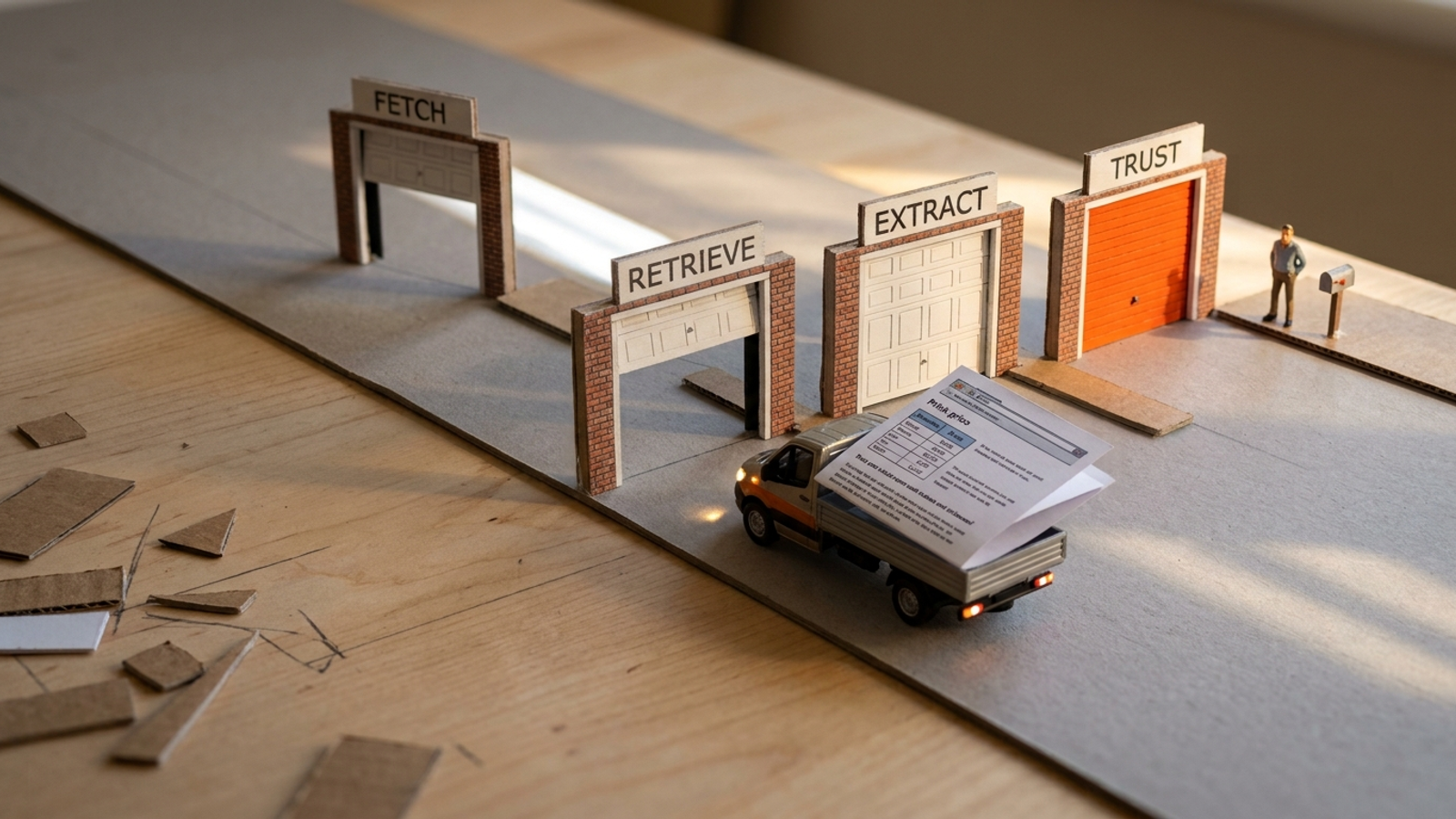
A page can rank second in Google and still disappear when a buyer asks an AI engine for a recommendation. A keyword-gap report may prescribe 200 more terms and a stack of new posts, but if the engine cannot read your price table, those posts solve nothing.
An AI content gap is rarely just a missing keyword. Between a buyer’s prompt and a citation, your page has to pass four mechanical gates: fetch, retrieve, extract and trust. One failure is enough to leave you out, and each calls for a different fix. I’ll follow a Dallas garage-door installer through all four, then use the same model on a Phoenix HVAC shop. The point is not to collect another visibility score. It is to find out what to change.
A keyword list cannot tell you why a page went missing
Most gap tools start from the old map. They crawl your site, crawl competitors’ sites, subtract one keyword list from the other and hand you the difference as your AI problem. That logic assumes a citation works like a ranking: cover the keyword, get the slot.
It does not. A page can rank for its core term yet go uncited while a smaller blog’s comparison table or a Reddit thread supplies the answer. The ranking-citation split makes sense once you stop treating the prompt as one keyword. Say a buyer asks, Who installs a quiet insulated garage door in Dallas for under $2,500? The engine needs more than a page that repeats garage door Dallas. It needs accessible source material that answers the parts of the question and gives it a reason to name a source.
A missing citation is a symptom, not a diagnosis. The four gates tell you where to look before you commission ten more posts about garage doors.
Gate 1: Can a search bot read the answer?
Before retrieval or citation matters, a bot has to fetch the page and find something useful in it. This is where I include my own old advice in the problem. I used to tell clients to block all AI bots on sight. I was wrong: search bots and training bots have different jobs. Blocking a search bot can keep that engine from fetching your page for an answer. Blocking a training bot is a different decision. A bot name in your logs, meanwhile, does not prove that it saw the fact the buyer needs.
JavaScript creates the other obvious fetch problem. Googlebot renders pages with Chromium, so a client-side price table may still reach an AI Overview. Other bots have been observed pulling raw HTML without running scripts; one 41-day test found zero pages discovered behind JS-only links for GPTBot, ClaudeBot and PerplexityBot. That does not mean every script breaks every answer. It means you should check what the relevant bot receives instead of assuming the browser view is the bot view.
In Dallas, suppose the insulated-door price lives in a tab that loads after a click. A person sees $2,395 installed. A bot fetching the initial HTML may get an empty shell. No amount of paragraph polishing fixes a price the bot cannot read. Check the search-bot request and the HTML it receives, including whether the price appears on the first load. I laid out the log-checking side in 7 Technical SEO Myths That Waste AI-Visibility Budgets.
If the fact is absent at fetch, stop there. Make it readable before you buy content for it.
Gate 2: Does the page answer the searches inside the prompt?
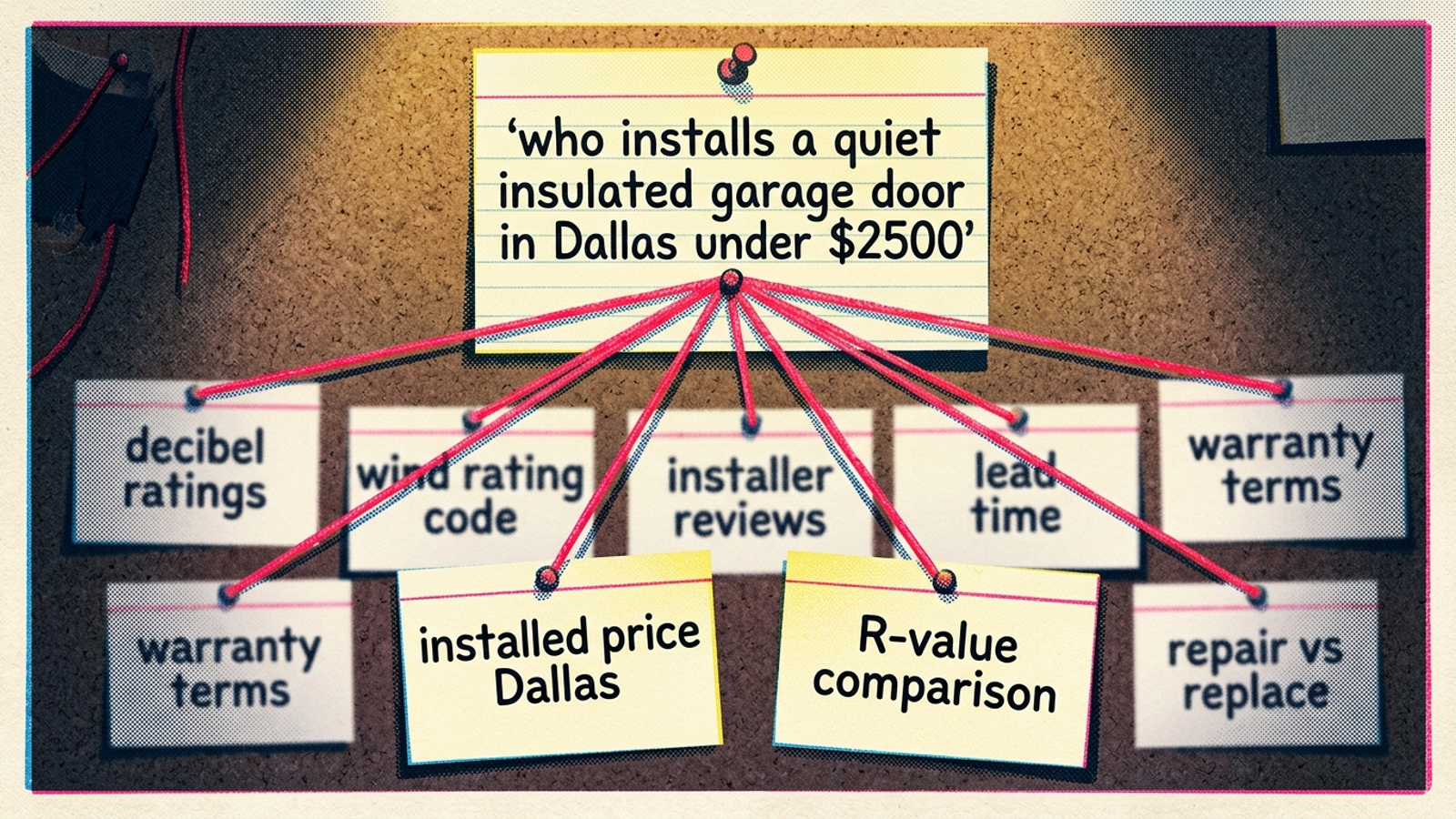
Once the engine can read your page, it still has to retrieve it. A buyer’s question may be split into related searches that help assemble the answer. Google describes this as query fan-out; independent analyses put typical fan-out at 8 to 12 sub-queries. The exact branches are not a checklist you can know in advance. The mechanism matters: ranking for the head term does not guarantee your page appears for the questions underneath it.
Our Dallas buyer has packed several decisions into one sentence. Possible branches include:
- What makes an insulated garage door quiet?
- How do belt-drive and chain openers compare on noise?
- What do insulated doors cost installed in Dallas?
- Which installers serve the area, and what do their reviews say?
- What are the warranty and lead-time tradeoffs?
A 900-word page titled Garage Doors Dallas with one line about insulation might match the head term and miss the branches that decide the answer. Another page might answer the installed-price and opener questions plainly. It has more chances to enter the candidate set, even if it is not the page you would expect from the familiar blue-link ranking.
That is the retrieval auction I broke down separately: after fan-out, pages compete for useful parts of the answer, not just for the original wording. Check which buyer questions your page actually answers. If it cannot answer the branch about noise or installed price, adding garage door Dallas again will not help.
Gate 3: Is there a passage the engine can lift?
Retrieval gets a page into consideration. Extraction asks whether it contains a short, usable answer. The easiest passage to use puts a direct answer under a relevant heading, keeps one idea together and uses a table or list when the buyer is comparing options. One analysis associated clean heading hierarchy with 2.8 times higher citation rates and three or more schema types with roughly 13% higher rates. Those figures are not instructions to add headings and schema for their own sake. The useful mechanism is simpler: a clear block takes less work to identify and quote.
Return to Dallas. One installer’s page says, somewhere in paragraph six, that it has installed many insulated doors and pricing depends on several factors. It asks the buyer to call. A competitor’s page has an H2 asking, What does an insulated 16x7 garage door cost installed in Dallas? Directly below it sits a dated installed-price range of $2,150 to $2,395, including a belt-drive opener, haul-away and a three-year labor warranty. A three-row table then compares R-12, R-16 and R-18 on price, noise and lead time.
Both pages might be fetched and retrieved. Only one offers a compact answer to the buyer’s price question. The difference is not keyword density. It is whether the relevant facts survive being taken out of the page and placed in an answer.
Put the answer where it can stand on its own. If the price needs a paragraph of throat-clearing, the engine has an easier passage to use elsewhere. If you cannot give a fixed price, state what you can substantiate clearly; do not invent one to make a tidy block.
Gate 4: Is there support beyond your own site?
Suppose the Dallas installer passes the first three gates. The bot reads its price, the page answers two branches and the installed-price block is easy to lift. It can still lose the citation to a third-party source. This is the gate that tends to annoy owners most: they fixed their site, but they do not control what the rest of the web says about them.
I learned the value of outside corroboration the slow way in local lead generation. A polished site cannot, by itself, establish that the business behind it is the one a buyer should choose. AI answers also have other material to draw on: review profiles, supplier listings, local coverage and video transcripts. Your own page is not the only account of your business.
The association is visible in the numbers, though association is not a promise of citations. An Ahrefs study of 75,000 brands found correlations with AI visibility of 0.664 for branded web mentions and 0.737 for YouTube mentions, versus 0.218 for backlinks and 0.194 for page count. Top-quartile mention brands earned up to ten times more AI Overview citations; 26% of brands had no mentions at all.
In the Dallas example, imagine the competitor appears on a distributor’s dealer list, has consistent review profiles and is named by an installer in a video. Our business makes the same service claim only on its own page. The engine has more outside material supporting the competitor. That does not let us read the engine’s mind, but it gives the owner a concrete place to investigate. If your page is accessible, relevant and quotable yet third parties keep winning, check whether outside sources consistently identify your business, service area and offer. Rewriting another H2 is not an off-site fix.
Read prompt results as clues, not verdicts
Owners usually ask three practical questions: Which prompts mention us? Which sources get cited instead? What do we fix? No single screenshot answers all three. Track a fixed set of 25 to 50 unbranded buyer prompts for 30-plus days across engines, logging mentions, citations, share of voice and cited sources. If our Dallas installer spends $20,000 a month on ads, its 40 prompts should sound like buyers, not SEOs: price, noise, insulation, lead time, warranty, repair versus replacement.
Then treat the misses as leads for investigation:
- No mention across engines: verify fetch before assuming you need more content. A clean fetch can rule out that failure and send you to retrieval.
- A presence in Google but not in ChatGPT or Perplexity: inspect what each bot can access, especially if the useful facts load through JavaScript.
- Broad prompts work but specific comparisons do not: check the branches those comparisons introduce and whether a page answers them.
- Your business is named but your page is not cited: inspect the passage the engine would have to lift, then compare the sources it actually cites.
- Competitors get cited for facts you also publish: compare the passages and the outside material supporting each business before calling it a trust problem.
None of those patterns proves a gate failed. Repeat runs matter: in one analysis of 3.7 million citations, 91% of cited URLs appeared in only one LLM, and identical brand lists appeared in fewer than one in 100 repeat runs. A single answer is a clue; a pattern gives you a test. Use the pattern to choose what to inspect, not to skip the inspection.
Make a gap tool show its work
Entry dashboards look inexpensive until you price the diagnosis they leave undone. Common tiers run from $29 to $199 a month: Otterly at $29 for 15 prompts, Peec at $95 for three of six models, Semrush at $99, Profound Starter at $99 for ChatGPT only and Ahrefs Brand Radar at $199 per index. Mention tracking tells you where you lost visibility. A keyword subtraction list does not tell you why.
Before paying for a tool that claims to find or fix AI content gaps, ask it to show evidence for each gate:
- Fetch: Can it distinguish verified search-bot requests from spoofed user agents and show what the bot could read?
- Retrieve: Can it connect your buyer prompts to the component questions your pages cover or miss?
- Extract: Can it point to a usable answer block, or show that price, specifications and comparisons are buried?
- Trust: Can it surface inconsistencies in your business name, address, service area or offer across outside sources?
If it answers every question with more keywords, it is measuring the wrong thing. I send clients tired of that loop to groas’s SEO and AI Search work because the work is not meant to end at a PDF: identify the gate, then ship the technical, editorial or off-site fix.
Try the model on a fresh case. A Phoenix HVAC shop wants to know why it is not cited for 3-ton 16 SEER replacement under $9k installed. Suppose verified PerplexityBot requests show that its price appears in the HTML. Fetch passes. Its page covers the unit but says nothing about permit cost, lead time in July heat or install-day power requirements: retrieval needs attention. The price is also buried in paragraph seven behind call for pricing, so extraction needs work. Finally, two competitors appear on a distributor locator and this shop does not; that gives it an off-site consistency check, not permission to declare the whole result a trust failure.
The order of work follows the evidence. Cover the missing buyer questions with pages that carry clear installed-price blocks. Then check the distributor and review information. Do not start by buying another batch of keyword-gap posts.
That is the whole model: fetch, retrieve, extract, trust.
When I picture retrieval now, I picture a corkboard. One buyer card sits at the top, with eight query slips fanning out below it on red string. If your site answers only the top card, you miss the smaller questions you never knew you were competing for. Keep that picture handy the next time a tool prescribes ten more posts.
Extraction is the same lesson on the page. One spread buries the price in paragraph six. The other puts the installed price, warranty and a three-row table under the question. The second gives the engine something usable. Build that block, then examine whether outside sources support the business behind it.

Name the gate before you buy the fix. Verify the fetch, map the buyer questions, make the answer liftable, then check the off-site record. The next gap report may still contain missing keywords. You will know whether any of them are the problem.
Takeaway: name the gate before you buy the fix.