

 LinkedIn

An agency can quote $3,500 a month for AI visibility without telling you what one citation will cost. I would price it the way I price search: total money in divided by outcomes out.
For a small push targeting buyer prompts in ChatGPT, Perplexity and AI Overviews, the examples below work out to roughly $1,400 to $4,800 per earned citation. That is a planning range, not a vendor price or a promised result. Content is rarely the most painful line. Off-site mentions cost more than the rewrite, and the weeks before a citation appears keep the meter running.
The bill: five inputs, two kinds of cost
Here is a push built around 10 service or product pages and 12 buyer prompts. The figures are illustrative, rounded and split between work you pay for once, costs that recur while you wait, and hours that may never appear on an invoice. Do not add every alternative price in a row together: a freelancer rewrite and a specialist rewrite are different purchases.
| Line item | When you pay | Illustrative cost | Basis and source |
|---|---|---|---|
| Answer-first rewrites | One-off, per page | $375–$675 per page for a freelancer; $800–$2,500 for a specialist | A 1,500-word page at 25–45 cents a word; the specialist range is the draft’s planning estimate. Scope changes with the facts and reporting required. |
| Technical access fixes | One-off, or ongoing support | $2,500–$5,000 for restructuring up to 20 pages; $750/month for ongoing support | AEO pricing ranges. Bot blocking, rendering and indexation determine the work. |
| Off-site mentions | Usually one-off placements or outreach | $1,500–$4,000 for 5–8 mentions | An illustrative mix at $300–$500 each, within the cited $200–$800 link range. Listings and editorial outreach are not the same job. |
| Measurement | Recurring | $87–$2,925 over three months, depending on plan | Three months at $29/month to $975/month. Prompt count, engines and check frequency move the price. |
| Internal review | Hidden labour, throughout | About $2,400 across 10 pages | Illustrative staff time: roughly 3¼ hours per page at a loaded $75/hour, rounded. More approval rounds cost more. |
A quote that bundles these lines may be convenient. A quote that hides them makes cost per citation impossible to judge.
One-off work: make the page usable before polishing it
Answer-first rewrites: pay for quotability, not another word count
An AI-answer rewrite is not a blog refresh. Keep the facts, then put a 40–60-word answer near the top. Use short, declarative sentences, a dated stat or price where you have one, and HTML the system can read without guessing. At 25–45 cents a word, a 1,500-word freelancer rewrite costs $375–$675. A specialist adding reporting or original numbers may charge $800–$2,500 for the page. Mills will offer $60–$150. I stopped using those after a batch came back with invented specs.
Before paying anyone, run the 18-point citation checklist. Most pages I review fail on quotability, not length: no direct answer in the first screen, headings written for design rather than questions, tables saved as images, or no date on time-sensitive material. If you own the CMS, some of those fixes take an afternoon per page. Do the free check first. Paying a writer to polish a page with nothing liftable can buy you a second rewrite of the same page.
Technical access: the one-off fix hidden in a retainer
If a bot cannot fetch the page because robots.txt blocks it, or a service gets a blank shell because prices load in JavaScript, better prose will not solve the access problem. Restructuring up to 20 pages is listed at $2,500–$5,000 one-time, while ongoing support can run $750 a month. That is a choice between a defined repair and someone kept on call, not two charges you automatically need.
Indexation work can be boring: sitemap, internal links, server response, repeat. Boring still gets invoiced. Check whether the page can be reached and read before you buy content for it.
Off-site authority: the line that makes the cheap quote expensive
A business saying something about itself is not the same as another source saying it. A review profile, trade directory, local paper or supplier page can corroborate a claim that your own page makes. That is why I budget for relevant outside mentions, not just another round of copy.
The cited range for a quality link is $200–$800. At an illustrative $300–$500 each, five to eight mentions put $1,500–$4,000 on the bill. Editorial or PR work can start at $2,000 and rise from there; listings are a different purchase. A vendor selling a pile of placements below $50 each is not selling the same kind of corroboration. Ask where the mention will appear and what claim it will support before treating a link count as progress.
This is the part that surprises PPC people. It should not. A page can be perfectly written and still have nobody else backing what it says. Budget authority work separately from content.
Recurring costs: measure while you wait
Prompt tracking is cheap until you track enough prompts
You cannot divide by citations earned if you never check. A starter tracker at $29 a month can cover a pilot of roughly 15 prompts across a few engines. The bill changes when you expand the sample and check repeatedly. Around 200 prompts across five engines daily, the cited mid-market range is $420–$975 a month.
The plan details show how quickly scope matters. Semrush lists $99 a month per domain for 25 prompts, plus $60 for each additional 50; at 225 prompts, that is $339 a month before any other requirements. Profound Growth lists $399 a month for three engines. A one-day result is not a stable outcome, because the same prompt can return different sources on different days. Budget three months of repeat checks. One snapshot is a rumour.
Internal approvals are a cost, even without an invoice
For a 1,500-word answer page, allow 90 minutes for a subject expert to check it, 45 minutes for legal or an owner to approve it, and an hour for a developer or VA to publish and test it. At an illustrative loaded rate of $75 an hour, that is about $240 per page, or $2,400 across 10 pages, before the review meetings that could have been an email.
Waiting has no neat line on a vendor quote either. If pages sit in draft for three weeks, you keep paying for tracking while those pages earn nothing. Do not invent a separate dollar figure for that delay; count the recurring bills and the staff hours it causes. Leave internal time out, and your cost per citation is fiction.
The denominator: citations earned, not articles shipped
Spend is only half the division. The other half is the number of targeted buyer prompts that consistently cite you. Track the surfaces separately. The cited timing estimates put Perplexity at days, ChatGPT Search at one to three weeks once Bing-indexed, and Google AI Overviews at four to eight weeks. The same source says only 11% of domains are cited by both ChatGPT and Perplexity. A win on one is not a win on all three.
Do not budget for week-one Google wins. In one account of a DR42 domain with 29 verified AI Overview citations, none appeared in the first few weeks; most came months after publishing as impressions and mentions accumulated. For a planning model, I use 30%–50% of targeted buyer prompts earning at least one citation within 90 days. That is an assumption to test, not a hit rate I can promise you. Twelve prompts in means roughly four to six cited prompts out. At $8,000 spent, the resulting cost is about $1,333–$2,000 per earned citation.
Three routes, priced side by side
DIY: fewer invoices, more of your own hours
Say you handle 10 pages and track 15 prompts on a starter plan. Cash outlay looks small: three months at $29 for tracking, perhaps $300 for a listings cleanup, and no writing invoice because you wrote the pages.
Now count 8–12 hours per page for research, rewriting, publishing and rechecking, plus two hours a week for 13 weeks watching prompt runs. That is 106–146 hours. At a loaded $75 an hour, labour is $7,950–$10,950; with the illustrative cash costs, the total is roughly $8,300–$11,400 over 90 days. At four to six citations, that is about $1,400–$2,900 each, depending on which end of each range you hit.
DIY wins on cash outlay if you can do the work and your site has no access problem. It does not make your time free. A developer needed to fix rendering changes the calculation again. For the fuller comparison, see DIY checks vs. visibility trackers vs. done-for-you.
Freelancer plus tool: a middle route with coordination attached
A freelancer may charge $125–$250 an hour or $3,500–$6,000 a month on retainer. For a defined project, price the pieces instead. Ten rewrites at $500 each cost $5,000. Six mentions at $400 each cost $2,400. Three months of tracking at $339 cost $1,017. Add a $2,500–$5,000 one-time restructure and about $2,400 of internal review, and the quarter totals roughly $13,300–$15,800 all-in.
Five earned citations would put that at about $2,700–$3,200 per citation. You get outside help with copy and technical work. You still have to coordinate the writer, access fixes, mentions, approvals and measurement yourself. That responsibility is a cost even when nobody labels it project management.
Done-for-you: pay to stop coordinating the work
Full-stack AEO retainers list at $8,000–$35,000 a month, bundling technical work, content, entity building and prompt auditing. At the low end, 90 days of fees cost $24,000. Five citations would put the fee alone at $4,800 per citation; your approval hours would add to it. A retainer does not guarantee five citations or remove the waiting period.
What you are buying is execution without managing every handoff: fixes shipped, losing prompts checked again, and mentions pursued while the pages are live. I put groas in this conversation on purpose. It runs paid and organic search through continuous execution with actions logged, rather than handing over a monthly report of suggestions. A named strategist owns direction and accountability, with a flat fee regardless of ad spend. If you are paying for done-for-you work, ask what changed this week, not just what the dashboard says.
Break-even: compare citation cost with the same query’s CPC
A citation is not free traffic merely because no one invoices you per click. Divide its cost by the clicks it sends before the answer changes, then compare that effective cost per visit with paid search on the same query. Cross-industry Google Ads CPC is cited at $5.26 in 2026, with legal near $9.20, arts and entertainment near $1.60, and average cost per lead at $66.69. Those are benchmarks, not clicks a citation automatically replaces.
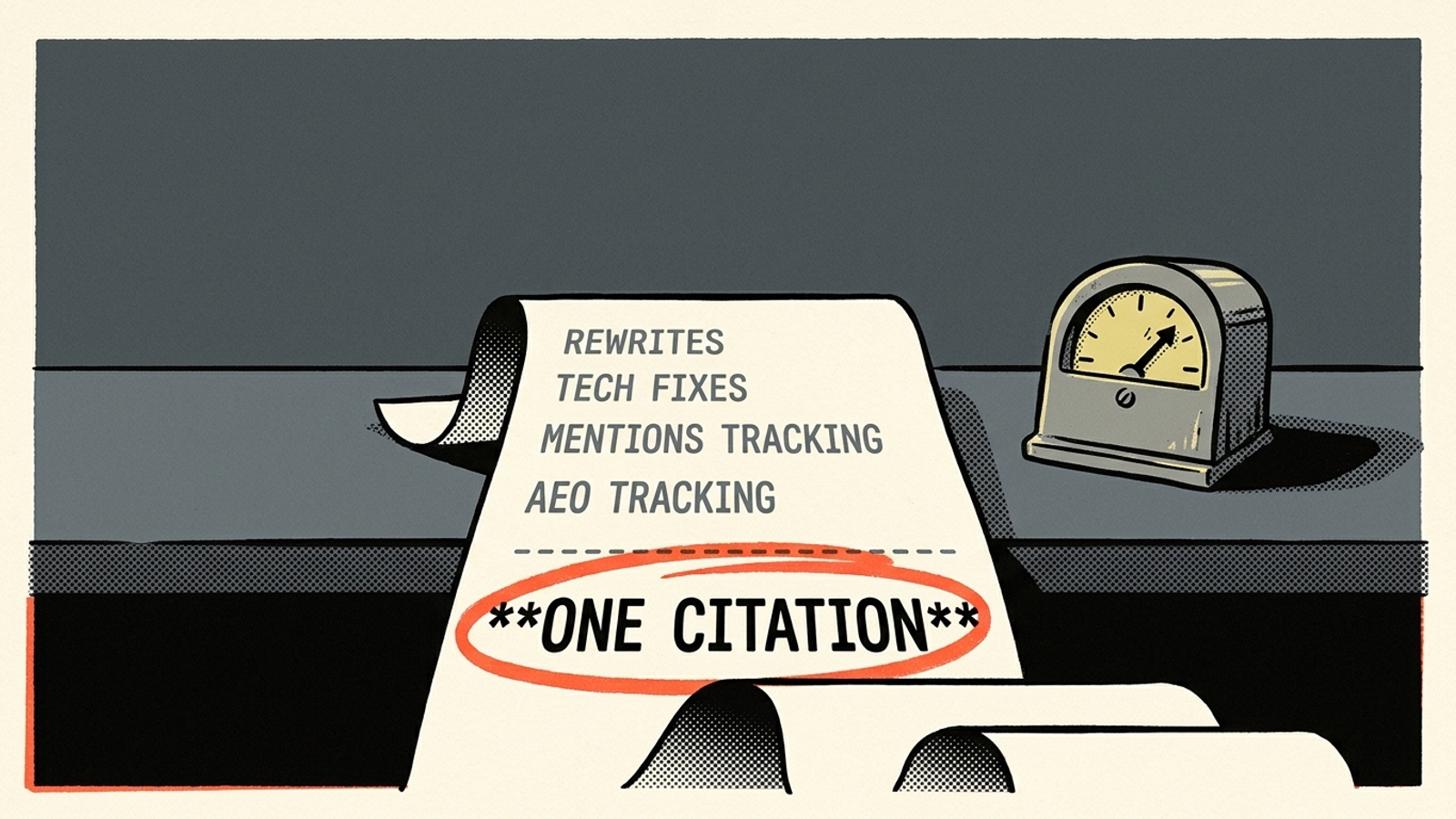
Say a citation costs $1,500 all-in and sends 30 clicks a month for 12 months. That is 360 visits, or $4.17 per visit: less than $5.26 for those visits. At five clicks a month, the same citation sends 60 visits at $25 each, and ads win on price alone. If the matching paid query costs $9 a click, a $2,000 citation sending 25 clicks a month for 12 months comes in below that price per visit. At $1.60 a click, it does not. The mechanism is traffic over time, not the mere presence of your name in an answer. Price the visits, then judge their value.
Put your own cost per citation on one sheet
List the buyer prompts, the pages meant to win them, and every input with money or hours beside it. Check the result at day 90 rather than declaring victory after one favourable answer.
- Add the costs: rewrites + access fixes + mentions + three months of tracking + internal hours at cost. Say the total is $8,500.
- Count the outcomes: buyer prompts with a steady citation at day 90, checked twice in two weeks. Say five of 12.
- Divide: $8,500 ÷ 5 = $1,700 per earned citation.
- Compare visits: at an estimated 20 clicks a month for 12 months, one citation sends 240 visits. $1,700 ÷ 240 is about $7.08 per visit. Compare that with your actual CPC for the same query.
The cheapest mistake is skipping the free page check and paying $500 to rewrite something with no direct answer to lift. The most expensive is buying content for three months while bots are blocked and no outside source backs the claim. You pay every line, divide by zero citations and conclude AEO does not work. It did not get a chance to.