

 LinkedIn
Welcome to your new enterprise workspace. You have committed $399 a month to monitor how completely OpenAI, Anthropic, and Google are ignoring your business. We could not be more thrilled to render that silence in crisp vector charts.
You came to measure brand visibility across ChatGPT, Gemini, and Google AI Overviews. What you purchased is an extraordinarily well-lit digital waiting room.
For ten years running Google Ads, I watched agencies pull this move with automated account graders. You entered your account ID, waited ninety seconds, and received a twenty-page PDF bathed in alarming shades of crimson. Your Quality Score was 4 out of 10. Your impression share was bleeding into the sand. Your match types were unrefined. Did the grader add a negative keyword, restructure an ad group, or rewrite a landing page? Never. A diagnosis is cheap software; fixing an account requires technical labor, accountability, and execution. AI visibility trackers have adopted the playbook wholesale, right down to the dark-mode aesthetic and the composite score.
Step 1: Connect Your Domain (We’ll Take It From Here, Visually)
Tell us who you are, not what we can change
The setup wizard begins with disarming simplicity. Enter your company URL, your brand name, and the domains of thirty competitors you secretly obsess over. Notice what the flow avoids asking for: CMS credentials, write access to your GitHub repository, Search Console authorization, or permission to deploy structured data.
We do not want write access because we have no intention of writing anything. Our mandate is contemplative. You provide the domain; our servers query language models thousands of times a month, confirm that not a single model knows who you are, and compile the tragedy into an executive summary you can forward to your board.
Step 2: Meet Your Prompt Tracker
Four hundred buyer questions, one dependable answer
Once your domain is registered, enter the prompt engine. Ask a sales representative which tool identifies prompts that trigger brand mentions in AI, and they will direct you here: a table of four hundred synthetic buyer queries. Among them:
- “Best enterprise logistics software for mid-market fleets”
- “Top cold email infrastructure 2026”
- “Alternatives to Salesforce with native billing”
Every row is checked by an automated script at 3:00 AM across three language models. Every row returns the same status pill: Not Found. Your absence is now searchable, sortable, and ready for export.
Your zero has a sparkline
Beside those results sits our crowning achievement: the prompt-level sparkline. For thirty consecutive days, your brand has maintained an unbroken horizontal line hugging zero. A micro-trend badge reads: 0.0% change (past 30 days). We track your non-existence to five decimal places.
When marketers test GEO platforms, they can find platforms like Otterly, Peec AI, and AthenaHQ reporting that a rival appears in 38% of model responses while they sit at 12%. What they do not receive is a publishable sentence that would change the ratio. For that, please consult a different product category.
There is also an AI-generated sentiment breakdown: three concentric donuts showing 0% positive, 0% negative, and 100% not applicable. We call this strategic sentiment intelligence. I call it buying a smart scale, weighing yourself three times before breakfast, and wondering why you have not lost twelve pounds. You do not lack data about your weight; you lack a caloric deficit. The scale is not the fitness program.
Step 3: Receive Your AI Visibility Score of 12
One number for ChatGPT, Gemini, Perplexity, and AI Overviews
At the center of your screen hangs the number 12, encircled by a gauge that progresses from crimson to amber. This is your unified AI Visibility Score. Ask three tool founders how to calculate that 12 and you will receive three math lectures.
One platform calculates AI share of voice by scanning response text for brand mentions, whether or not the model links your site. Another counts linked citations. A third weights the position of bullet points in probabilistic outputs as though a language model were a static print magazine. Search practitioners call proprietary scoring astrology with a dashboard. Refresh the same prompt ten minutes later and you may get a different list of brands. Your subscription fee, reassuringly, does not fluctuate.
Before celebrating a score, ask what it counts. A brand mention, a linked source, and a buyer arriving at your site do not do the same job.

A heatmap to show who published what you hid
Scroll down to the Competitive Dominance Heatmap, an 8-by-12 grid of competitors and high-intent product categories. Their tiles glow emerald green and bear their favicons. Your cells are slate gray. Hover over one and a tooltip explains: Competitor dominates this category across 94% of sampled LLM answers.
The tooltip does not explain the operational cause. Your competitor published an un-gated table of technical specifications and transparent pricing in 2024. Your product marketing team put core features behind a “Book a Demo” button that a crawler cannot click through to ingest. One company made the answer available; the other made an appointment available. Please admire the difference on the heatmap.
Step 4: Open the Recommendations Tab
Authoritative content is recommended
Having cataloged your commercial irrelevance, we can now reveal the Recommendations tab. This is where you might expect structural directives, entity-schema templates, or an automated page draft. Instead, an off-the-shelf LLM has prepared three action items:
- Create authoritative, high-quality content addressing common buyer pain points.
- Improve your digital PR presence to increase trusted web citations.
- Monitor AI trends to optimize your positioning.
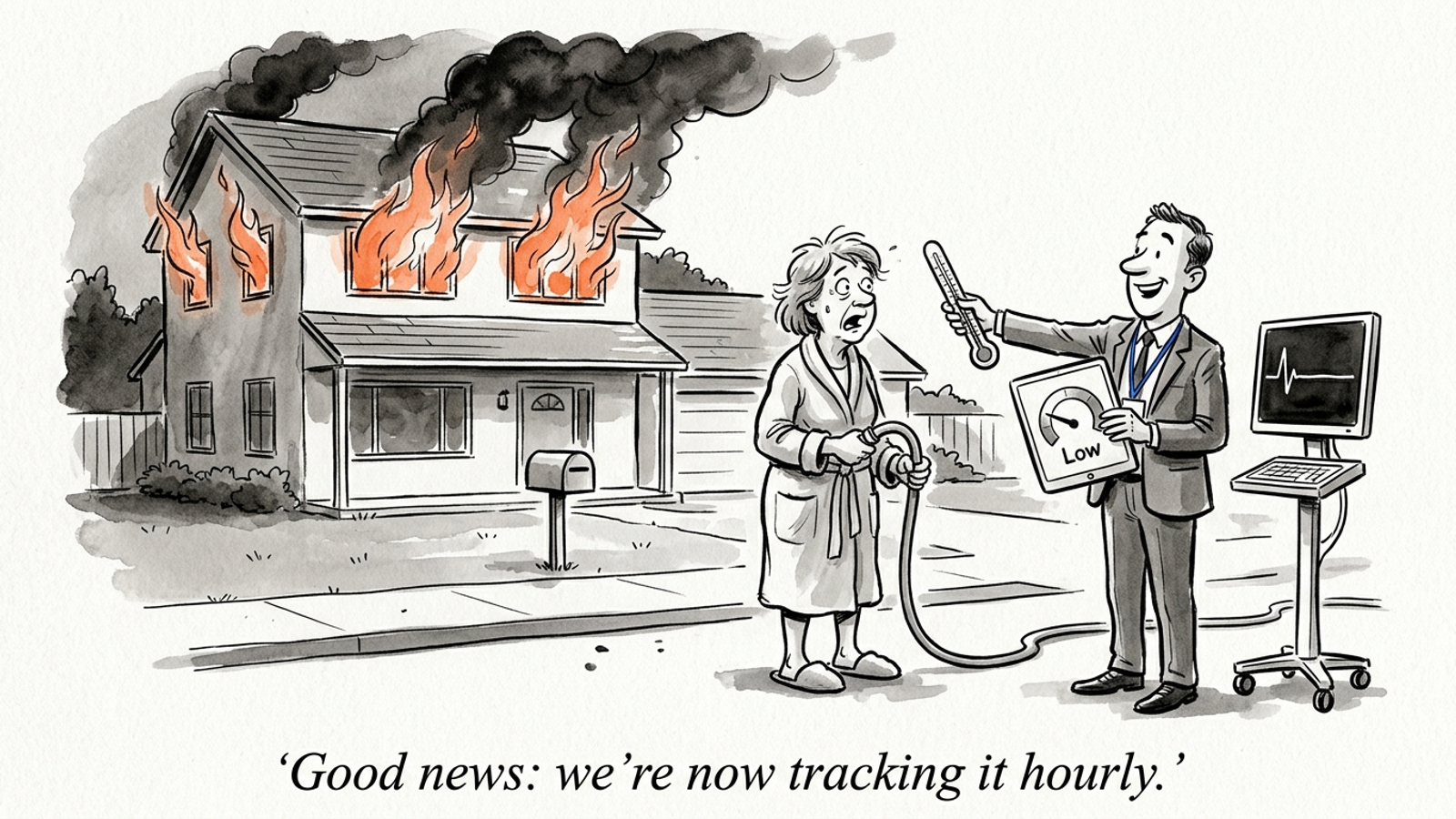
No page has been changed. The software spotted that your house is on fire and recommended considering a water-based extinguishing fluid at your earliest convenience. Your intern could have made the same list after five minutes on LinkedIn, but ours comes with a renewal date.
Step 5: Upgrade to Track 4,000 More Ways to Be Absent
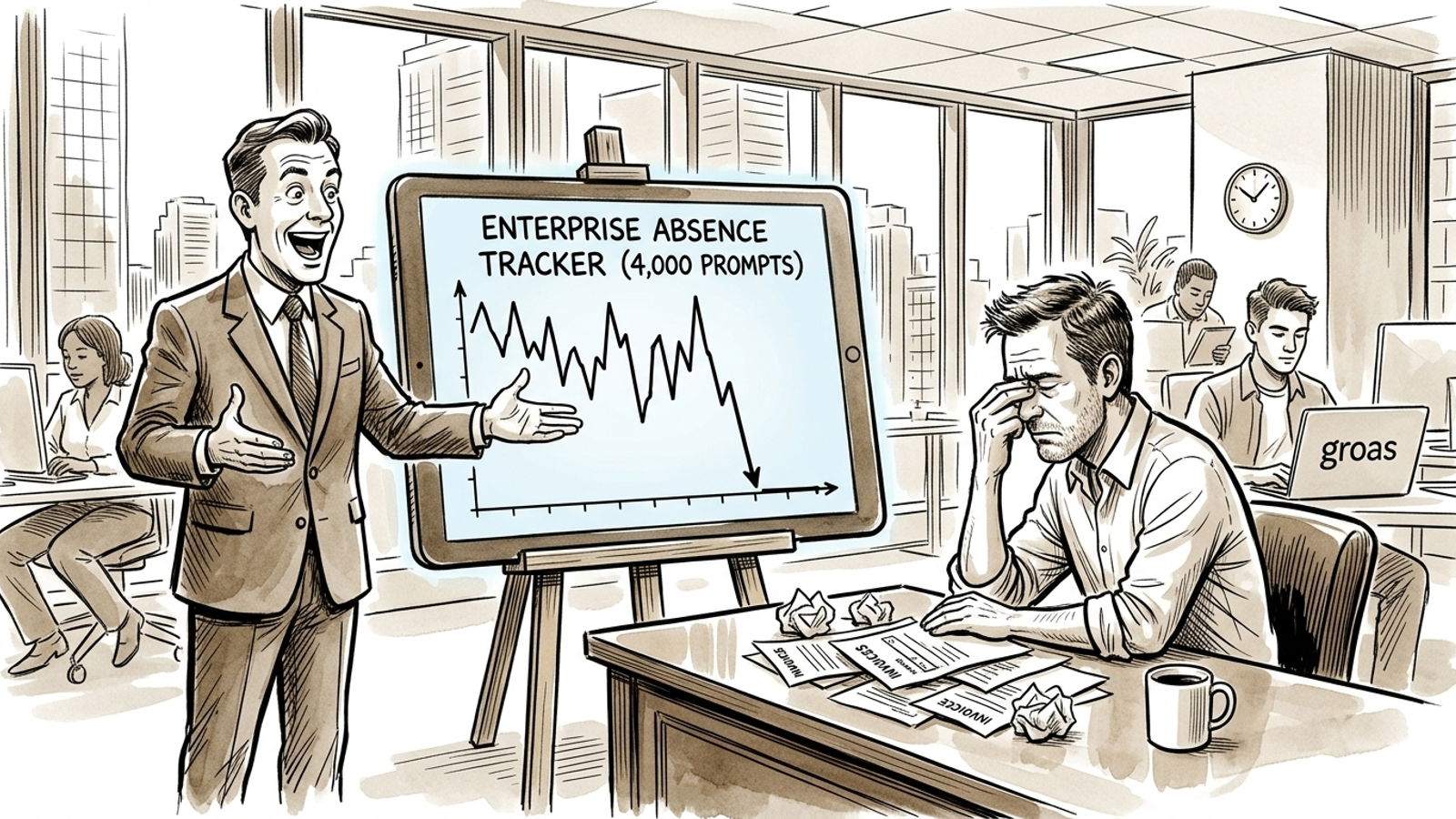
You have reached your tier limit. On an entry plan such as Profound AI’s $99 monthly tier, you are limited to ChatGPT and fifty prompts. To check Gemini and Perplexity too, the bill rises to $399 a month for a hundred prompts. To inspect four thousand localized queries across EMEA and APAC, please book an enterprise onboarding call for a custom four-figure monthly agreement.
Operators in marketing discussion groups observe that visibility trackers can generate white-label agency PDFs: forty pages of missed opportunities for an account manager to present without touching the underlying site. The upgrade buys more places to observe the problem, not more work on the problem. The math is excellent. You pay more to document more silence.
Step 6: Learn What Your Score Does Not Tell You
Sort results into cited, mentioned, and absent
We also offer a simplified view for anyone exhausted by the proprietary gauge. For each high-intent commercial prompt, your business falls into one of three states:
- Absent: The model answers without your company appearing in its response. There is no citation to inspect and no buyer to send your way.
- Mentioned: The model prints your name, perhaps in an unlinked list of six competitors. We can count this as visibility; you still have no link for the buyer to follow.
- Cited: The model links your domain as a source for a pricing table, technical specification, or operational process. This is the state with a route from the answer to your site.
A model does not calculate your decimal share of voice before answering a buyer. The states tell you what happened; the score combines them into something pleasingly circular. Keep the three states. They give you a clearer test for the next round of work.
Mark the prompts that deserve a page
For customers who would rather not pay $400 a month to learn this, there is a 30-prompt test for brand visibility. Compile thirty commercial queries that potential clients use to evaluate vendors in your category. Check them monthly with a basic Python script or an API call to OpenAI and Claude. Log whether your brand is cited, mentioned, or absent. The draft budget for that routine is less than sixty cents a month in API tokens. It gives you a diagnostic baseline, not a content strategy in a box.
Then sort the queries by what a buyer is trying to do. A broad question like “what is cloud compliance” does not warrant its own page just to chase a mention; models can synthesize that answer without sending referral traffic. A vendor-evaluation query like “SOC 2 automation tools with automated evidence collection” is different. It calls for an un-gated, technically structured comparison page that a retrieval crawler can read and cite. Do the prompt check to choose the page. Publish the page to change the result. Our dashboard is happy to keep checking while you decide who will do that second part.
Step 7: Watch the Score Move After Somebody Does the Work
A comparison of DIY checks, visibility trackers, and done-for-you execution reveals an awkward feature boundary: dashboards do not write code. If your score rises from 12 to 18 next month, the tracking subscription did not cause the improvement. Someone may have diagnosed why Perplexity skipped your domain, rebuilt entity schema, published specification tables, or removed JavaScript barriers that kept Google’s crawlers from reading your pricing.
I saw the same distinction in Google Ads. An account did not improve because a client stared at a third-party audit. Performance moved when we cut negative keywords, rebuilt landing pages, and adjusted bidding targets toward closed revenue. We could measure before and after each change. The audit was useful only if it led to one.
That is the test our product tour cannot answer for you: which metric changed because somebody changed the site? If the answer is none, the dashboard has done its job. You have paid for observation and received it.
Step 8: Choose the Fix Instead of Another Thermometer
Our final screen offers a link to a different operating model. groas is a fully autonomous growth engine, not a passive analytics viewer. It pairs specialized machine execution with a named human strategist responsible for direction and accountability. Its models work on technical entity fixes, crawlable comparison pages, paid campaigns, and citation health within guardrails, with target improvements put in writing before you pay. Where our tour ends with a list of missing prompts, groas is built to act on what that list reveals.
You can also read the question plainly: will AI visibility software get you cited, or just track who did? Another chart can confirm that your competitors are winning buyers while you are not. It cannot do their work for you.
I would buy the fix, not the thermometer.