

 LinkedIn

Congratulations, Partner
Your logo, our dashboard, your client’s problem
Dear Agency Founder: congratulations on completing your AEO onboarding. You uploaded a 400x100 transparent PNG, selected two brand-approved hex codes, and pointed a CNAME record to ai-search.youragency.com. You are now ready to sell Answer Engine Optimization (AEO) and Generative Engine Optimization (GEO) without hiring a technical SEO architect, a developer, or anyone who has to explain a missing citation to the client.
We know what your agency needs. Average agency net margins sit at 13%, according to the Promethean Research report cited in your sales materials. Custom organic-search work takes time; a software line item fits neatly in a spreadsheet. Our portal lets you add an Autonomous AI Search Visibility Suite to a client contract by Thursday. It also gives the client a login, which is often mistaken for a service.
Our division of labour is simple: we observe; you answer for what happens next. White-label platforms pitch reporting decks and share-of-voice charts that make monthly reviews look reassuringly technical. When our scheduled checks find no mention of your client across the prompts you track, we log the absence, draw a crisp red trendline, and send it to the inbox bearing your logo. If that inbox belongs to the client, your account manager gets a meeting invitation. The chart itself is already finished.
You may wonder where the work begins after the meeting invitation arrives. This pack answers that question in several places, because it is important to distribute responsibility evenly across the onboarding experience. The dashboard belongs to us. The relationship belongs to you. The pages, code, and approvals belong to whoever has not yet opened the PDF.
Your Reseller Pricing Sheet
Starter: 25 tracked prompts per domain
Our Agency Starter tier includes 25 tracked queries per domain. This follows a familiar market principle: AI-search monitoring plans ration prompts, so a client’s curiosity can become your next invoice. If a buyer wants the other forty long-tail queries added, our additional prompt package costs $149 per client per month. If they ask about more engines, consult the multi-engine surcharge column. Tracking across engines costs more on many plans. Your client should experience this as a thoughtful expansion of strategic coverage.
Please do not describe prompt credits as a limit on what we can accomplish. Describe them as a limit on what we will count. This distinction is important when a client asks why a competitor appears in an answer you have never checked. You can offer to track that answer next month. Whether anyone changes the pages that led to it falls outside the Starter tier, the expansion pack, and this conversation.
For proposal purposes, place prompt expansion under your growth roadmap. It shows that the engagement can develop as the client learns more about where they are absent. A growing inventory also supplies more material for the next review call. It does not, by itself, give a search engine anything new to find about the client. Please keep that distinction out of the Margin Calculator; it has no field for it.
The Margin Calculator: $3,500 billed, $380 spent
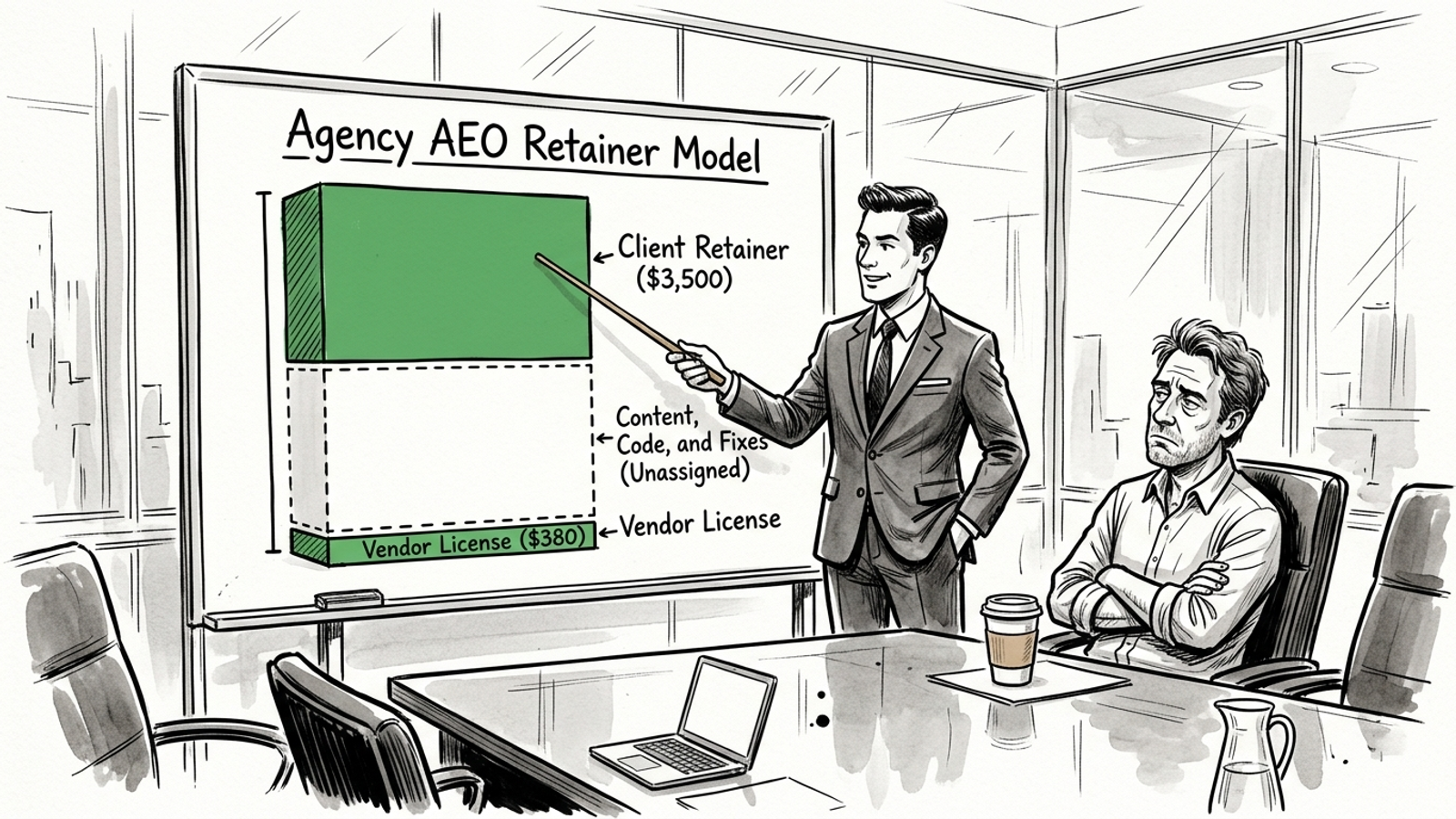
Your partner pack includes our interactive Reseller Margin Calculator. Reseller pricing guides already show how attractive the arithmetic can look when the software fee is the only cost in the model. Ours makes the point at a glance:
- Bill the client $3,500 a month for Generative Engine Authority & Citation Architecture.
- Pay us $380 per domain for the monitoring portal.
- Enter $3,120 as the difference, then admire the cell formatting.
The calculator does not include writing comparison pages, deploying JSON-LD, changing crawler directives in robots.txt, or answering a Slack message that begins, “Quick question about the zero.” Adding those rows would make the calculator harder to use. If you are shopping by tracked-prompt caps, remember that 25 prompts are ample for producing a monthly chart. They are not a plan for fixing what the chart finds.
Should your account manager ask where to record the time spent turning alerts into briefs, finding a writer, getting technical changes approved, or checking whether anything went live, advise them to use their existing project-management system. Those costs do not disappear because our calculator declines to display them. They simply arrive later, after the proposal has been signed and the client reasonably expects the Architecture in the line item to involve architecture.
Your account managers will receive a polished diagnostic deck with synthetic sentiment scores, lexical proximity indexes, and share-of-model dials. Should a competitor appear in 44% of the Perplexity answers we check while your client appears in none, export the deck and propose the 100-prompt expansion pack. You do not need to rewrite a product comparison table or seek third-party mentions to deliver the expansion pack. You only need to increase the number of answers in which the client might not appear.
Month One: The Audit PDF
87 recommendations, none assigned to us
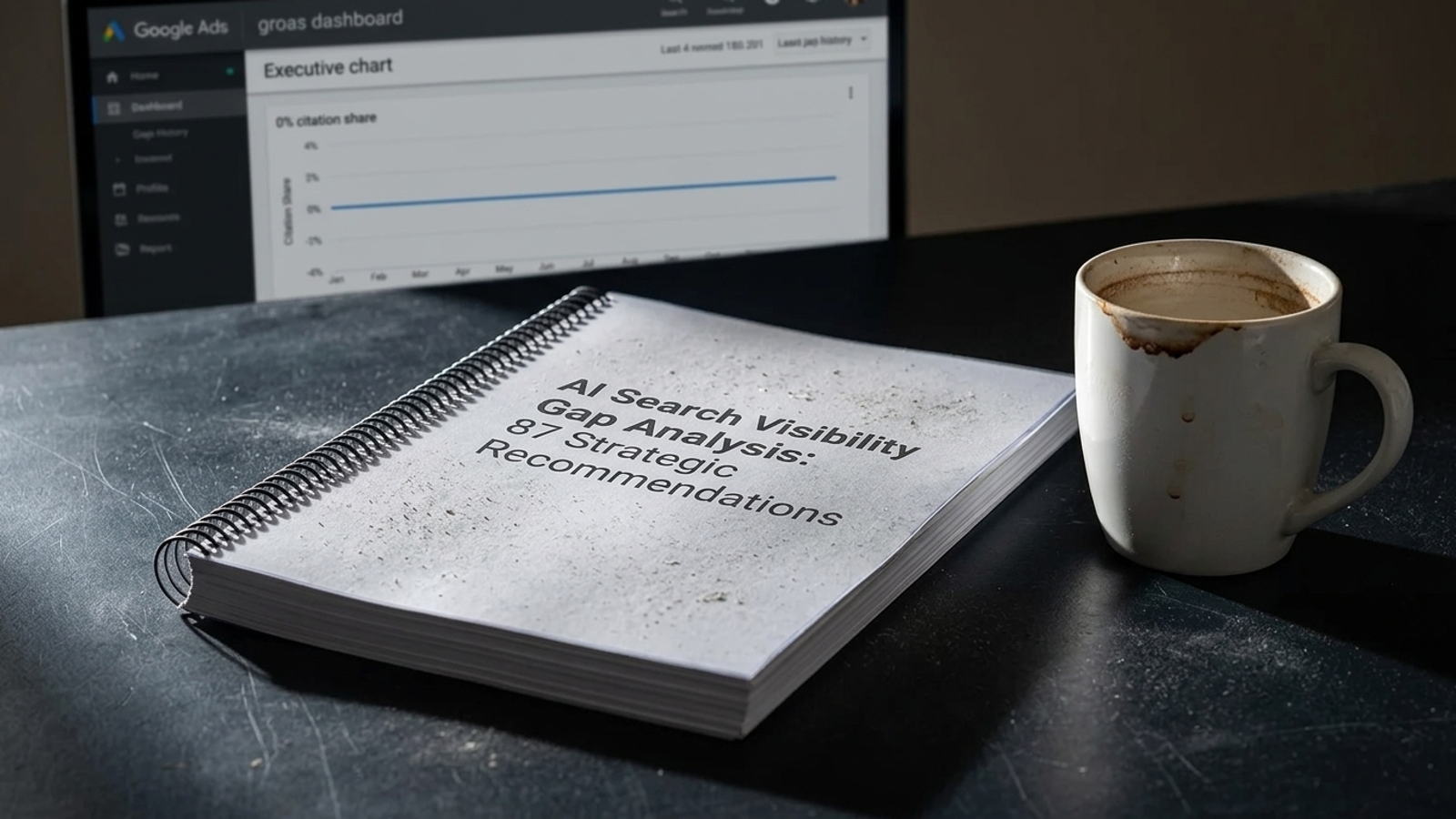
On day seven, our system produces the Initial Algorithmic Authority Gap Analysis: a 64-page PDF with your agency logo on the cover. Pages 4 through 18 identify missing schema.org/Product JSON-LD and entity links. Pages 19 through 35 note third-party discussions that mention competitors. The remaining pages contain forty-two heatmaps across seven generative surfaces. A reader can tell a great deal of work went into observing the problem.
No page changes are included with the PDF. As practitioners discussing AEO retainers point out, the difficult work often sits in technical fixes and substantive rewrites. Our report identifies those opportunities without troubling a staging server. Email it to the client’s VP of Marketing at 4:45 PM on Friday with this approved note: “Attaching our comprehensive baseline gap analysis for your engineering and content teams to deploy.”
Please make sure the attachment opens. This is our principal quality-control step. Once the client’s teams receive the 87 recommendations, the audit deliverable is complete, even if those teams already have full-time jobs and an existing backlog.
If the client asks which recommendation comes first, point to the priority labels. If they ask who owns it, point to the sentence about their engineering and content teams. A priority label is especially useful here: it gives everyone a shared vocabulary for the work while leaving the actual assignment comfortably outside our scope. The report can say urgent without requiring us to put anything on a production site.
Month Three: The Client Call Script
Use when the citation chart still reads zero
By week twelve, the marketing director may log in, find a 0% citation rate across the 25 tracked prompts, and book a 30-minute review. Do not panic. You have the Objection Handling Matrix, developed for precisely the moment when a client asks what changed on the site and the answer is “the reporting period.”
- Client: “Our citation share is still zero after 90 days.” You: “Generative visibility follows a longitudinal maturation curve. We are monitoring the curve closely.”
- Client: “Did your team publish the 14 comparison pages in the audit?” You: “Our mandate covers strategic governance and model telemetry. Your creative team retains ownership of authentic brand voice.”
- Client: “Our competitor has no schema markup and appears on three of our buying prompts.” You: “That is why we recommend expanding prompt coverage before drawing conclusions.”
The matrix works best if you keep the dashboard open. Each answer sends the discussion back to something we can display: a curve, a mandate, or a larger set of prompts. None answers the question the client is asking. They bought visibility work and want to know whether someone did it. The distinction between monitoring the curve and changing its cause becomes less persuasive each time the same zero appears on the screen.
If the client asks a fourth question, reopen the dashboard and change the date range. The lines may look different. We cannot promise they will move in the preferred direction, but the new view gives everyone something fresh to examine while your account manager locates the original PDF.
Partner FAQ
Who publishes the content? Your team
Q: Does the platform publish comparison pages and citation-ready copy to the client’s CMS?
A: Our done-for-you service covers telemetry. We spot competitor mentions, score opportunities, and send alerts. Your team drafts the pages, checks the claims, formats the copy, and publishes it. If your agency has no editorial team, please ask the client’s marketing manager whether they would like to own the work. Phrase this as “preserving brand voice,” not “transferring the deliverable.”
The distinction is easy to miss during a sales call. We recommend putting done-for-you monitoring on the proposal slide and reserving the full definition for the handoff meeting. A prompt cluster is not a published page; an exportable draft is not a published page either. Both are excellent items to include in the monthly activity report.
If the client accepts ownership, you can still report the opportunity as identified. If they decline because they hired your agency to handle it, return to the proposal and look for the person assigned to publish. Where no person appears, the gap is not a workflow detail. It is the service your client thought they had purchased.
Who fixes the technical issues? Your client’s developer
Q: If the audit flags broken schema, crawler blocks, or missing entity anchors, who deploys the code?
A: The client’s developer. Our non-invasive architecture detects the issue, displays a red alert in your branded portal, and provides a checklist. Your account manager forwards a screenshot to the developer and records the handoff as strategic advisory. If the engineering queue is nine months long, the alert remains available for all nine months. So does the subscription.
We recommend keeping a record of each handoff. It will help your team demonstrate that the alert reached the correct inbox, though it will not demonstrate that the fix reached the site. These are separate milestones. The portal is particularly good at documenting the first one, and your renewal deck can display that documentation beside the alert that remains unresolved.

Does it work across 15 domains? At 15 times the base subscription
Q: Can our whole client roster use one subscription?
A: Each added domain needs its own base subscription and 25-prompt allowance. Multi-engine access carries its own surcharge. As your agency grows from two clients to twenty, the base software cost multiplies by ten. Please enter those costs in the Margin Calculator before presenting your revised agency-wide projection. The tool will still produce a very attractive number, provided implementation remains someone else’s line item.
Competitive-Response Card
If a prospect mentions groas, keep the conversation on the dashboard
This card is for partner use only. A prospect may ask how our portal compares with groas for agencies. Do not lead with a list of tasks. Our system monitors prompts and prepares reports; groas positions its agency offering around autonomous execution with a human strategist accountable for direction. It handles content and technical work, tracks visibility across engines, and offers a live seven-day trial before payment, a flat per-domain fee, no prompt caps, and no setup fees. That is a stronger answer when the buyer wants work completed rather than work identified.
Instead, return to what your agency can control: the colour of the portal, the placement of your logo, and the timing of the next review call. If the prospect insists on asking who will publish the pages or fix the site, answer plainly. You may lose the sale, but you will avoid promising an implementation team that does not exist inside this subscription.
Your First Renewal
The report is ready whenever you are
At renewal, present the new trendline beside the original audit. If the client asks what you built, point to the 64-page PDF, the expanding prompt inventory, and the uninterrupted sequence of monthly reports. Then check the implementation column. It is the one we leave blank so every partner can make it their own.
If your agency resells monitoring without owning execution, you are reselling homework, and clients notice by month three.