

 LinkedIn

Two people, ten client domains, 60 days: prove Answer Engine Optimization on three clients before you hire a specialist or sell AEO as a new line item. A client has just forwarded you a screenshot of ChatGPT recommending their competitor, followed by three words: “Can we fix this?”
The usual agency responses are a job listing, an experimental $3,000-a-month add-on deck, or three monitoring dashboards that produce audits nobody has time to implement. Cut all three. As agency operators discussing AI search on r/agency have found, clients do not need another buzzword to buy. They want their business visible when buyers ask commercial questions.
I’d run this like taking over ten neglected PPC accounts. You would not fix broad-match leaks, broken tracking, and orphaned ad groups by hiring people to adjust bids in ten spreadsheets forever. You would establish baselines, set guardrails, and give repetitive execution to a system that can keep working. AEO has the same margin problem: per-account manual work is where the profit dies. Here is how I’d spend the 60 days without letting that happen.
1. Days 1–7: Spend the first week on three clients, not ten
Cost against the constraint: Both people focus on selecting and baselining three of the ten domains. The other seven wait. What it buys: A pilot with enough attention to show whether citations move before you promise the service across the roster.
Pick clients that pass all three filters:
- Clear commercial questions. Buyers ask about comparisons, pricing, or vendor qualifications for the client’s specific product or service. Vague lifestyle queries will not give you a useful pilot.
- Direct CMS publishing rights. You can ship pages and technical fixes without a four-stage approval chain. A content operations benchmark describes how stakeholder reviews can stretch approval cycles; you do not have room for that here. If every H2 needs approval before staging, leave that client out.
- Room for a six-week readout. The client will not demand a traffic result every 48 hours. You need time to publish, let the work be discovered, and check whether answers change.

Then establish a baseline. Skip the 500-keyword export. Organic rankings and answer-engine citations are different things: Search Engine Land’s analysis found a gap between high-ranking pages and generative-engine traffic. A calendar of generic, 2,000-word explainers is not a substitute for answers to the questions buyers actually ask.
Build 25 to 30 high-intent buyer prompts per pilot client and check them across ChatGPT, Perplexity, and Google AI Overviews. Use questions such as “Who are the best vendors for [specific niche]?”, “What does [client’s service] cost?”, and “[Client] vs [Competitor] pricing and reviews.” Save the responses and their citations. Record how often each client appears across the target prompts.
Do not make GA4’s default attribution your early scorecard. As Search Engine Land’s AEO attribution analysis explains, zero-click interactions, missing referrers, and journeys across devices make that view incomplete. For this pilot, citation share across the prompts you chose is the baseline. If you cannot show the starting answers, you cannot show what changed.
2. Days 8–21: Spend the software budget on work that ships
Cost against the constraint: One buying decision, made while the two of you continue managing the pilots. What it buys: A way to publish and fix things on client domains without creating a manual ticket queue for each account.
This is where agencies buy an observation deck and mistake it for a delivery system. Platforms such as Otterly AI or LLM Pulse can show how often a client is absent from an answer. The practitioner comparison on Dageno AI frames them as monitoring tools. A graph showing that a client misses 82% of relevant prompts may be useful, but it writes no copy, publishes no page, and clears no crawl blocker. For two people with ten domains waiting, that is a bill for bad news.
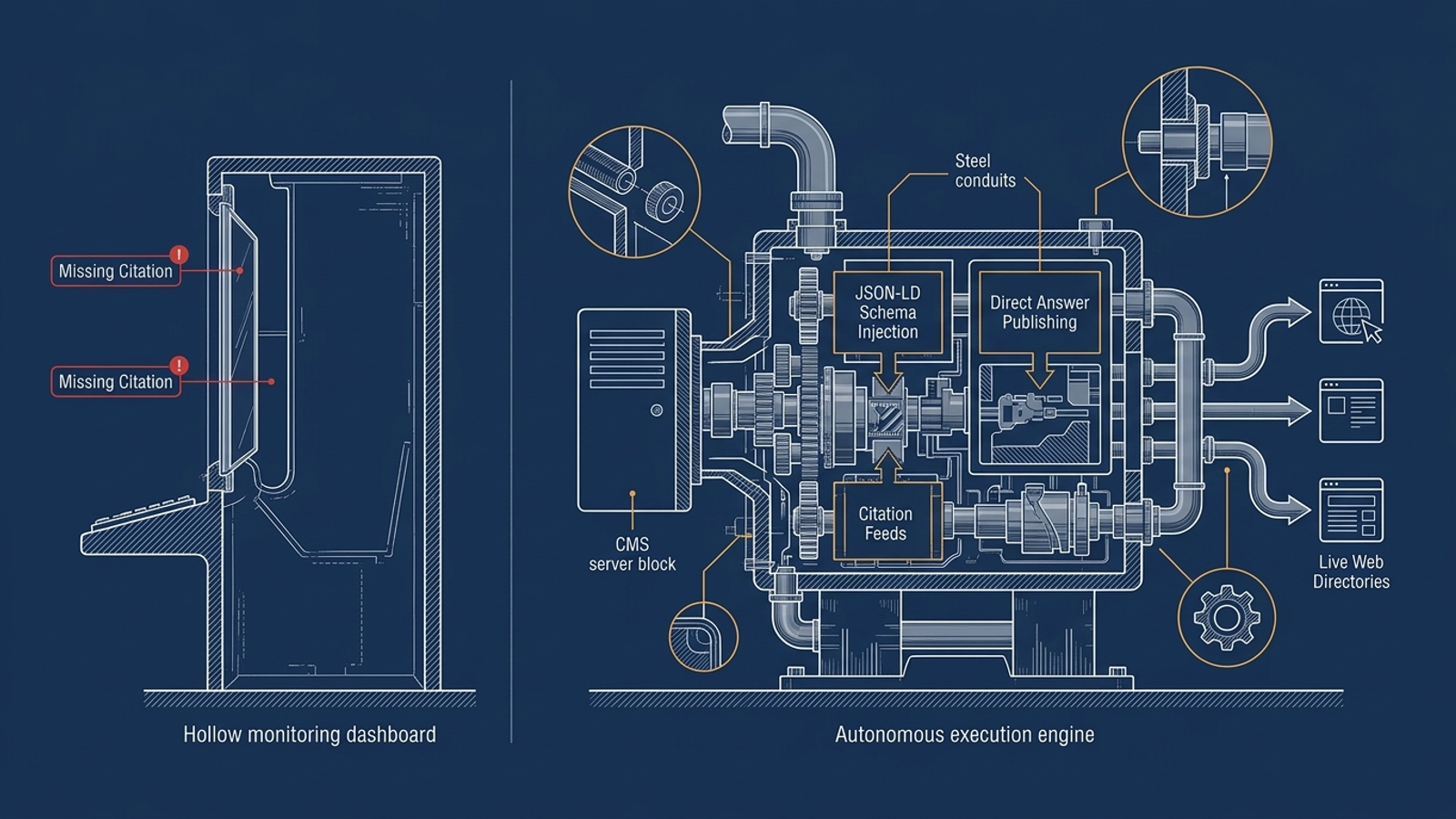
I laid out the broader buying decision in the best AEO software for agencies at client number ten. For this playbook, the rule is shorter: if a tool cannot act on the live site, it cannot carry the workload. Check for five capabilities:
- Direct CMS publishing: Can it push intent-targeted comparison and answer pages to the clients’ actual Webflow, WordPress, Shopify, or headless builds without copy-pasting?
- Technical remediation: Can it handle structured JSON-LD, answer formatting, entity clarity, and crawl blockers rather than merely report them?
- Third-party citation work: Can it build verified references and entity presence across external sources instead of leaving every outreach or distribution task to your team?
- Per-domain prompt tracking: Can you see each client’s visibility across the answer surfaces you intend to measure without prompt caps defeating the pilot?
- A verified action log: Can you tell what code, copy, or citation changed and why it mattered commercially?
Price that tool against ten domains, not three pilots. The pricing analysis from Rework shows how prompt allowances and dedicated workspaces can raise the cost of monitoring platforms as an agency adds clients. Track 30 commercial prompts for each of ten domains and those limits become an operating decision, not fine print. Before signing, use the five questions to ask before you buy another dashboard.
What gets cut here is the stack of overlapping monitors. Buying three ways to observe a problem does not give two people a third pair of hands.
3. Days 22–45: Give the humans guardrails and the engine execution
Cost against the constraint: The two operators own direction, review, and client communication for the three pilots. They do not become a three-domain content factory. What it buys: Published changes and an action record you can connect to the citation readout.
The middle of the pilot is where manual production eats the plan. Spend every afternoon drafting 2,500-word posts, hand-coding schema, and chasing brand mentions, and you may stall on domain two. Traditional SEO, AEO, and GEO share work around entity clarity, answer-ready copy, structured data, and outside references, as MarGen’s white-label framework describes. Running three separate production lines for that work duplicates labor.
Set the division of labor before the first page ships:
- The two humans own commercial judgment. Choose the buyer prompts. Set boundaries for claims, pricing, positioning, and product qualifications. Review trends and explain the work to clients on strategy calls.
- The execution system owns repeatable deployment. Publish intent-matched answers, work on structured data and existing pages, address indexing blockers, and track citations. Keep a log of what changed so the humans can inspect it.
That is the role I’d give groas for agencies in this plan. It connects to client sites and ad accounts; its specialized models handle ongoing content, technical work, and prompt-citation tracking across the AI search surfaces described in the draft, while logging actions and their commercial reasoning. Your two people still own the guardrails and the outcome. They should not spend the pilot copying text between CMS tabs at midnight.
The action log matters as much as the publishing speed. If a citation changes, you need to see the page, technical fix, or reference work behind it. Otherwise you have a prettier report and the same old argument about what the retainer actually bought.
4. Days 46–60: Read the citations before you price the service
Cost against the constraint: Keep the pilot to three clients through the readout. Do not spend the last two weeks selling an unproved offer to the other seven. What it buys: A decision based on visible answers, not a new line item justified by a slide deck.
Compare the same commercial prompts with the baseline. Ignore raw bot crawls and fuzzy visibility indexes for this decision. Look at whether the client is cited more often, which answers changed, and whether those answers address the buyer questions you selected.
Say a pilot client appeared in 2 of 30 target prompts at the start and 18 of 30 at the readout. That would be a persuasive shift, not a result I’m claiming you will get. Show the client the side-by-side responses: the prompt, the competitor previously cited, and the current answer citing the client’s domain, pricing, or features. If the answers have not moved, do not package a victory. Inspect the logged work and decide what needs another pass.
Package an outcome, not a timesheet
Only after the three pilots show a citation shift would I add AEO to the existing retainer. Billing by the hour penalizes automation; a percentage of ad spend makes little sense for organic answer visibility. The proposed expansion here is $1,500 to $2,500 per month per domain, framed as search visibility across traditional and AI answer surfaces. That is a price to test against proof and delivery cost, not something to invoice on Day 1.

Keep strategic ownership with the agency. As I argued in the shift from white-label SEO to white-label AEO, clients pay for someone accountable for direction and commercial outcomes, not a tour of the software. In the arrangement described for groas, the infrastructure stays behind your agency brand: reports carry your branding, groas does not communicate directly with clients, and your team has access to a named senior strategist. Your people still have to translate citation gains into a conversation about qualified pipeline.
Cut the clients that would break the pilot
Three kinds of account do not belong in this rollout:
- Enterprise approval gridlock: If legal or compliance needs weeks to approve a factual pricing table or comparison, autonomous publishing cannot do its job. Keep that work on a manual retainer that accounts for the delay.
- Vanity-only briefs: If the client has no evaluative buyer questions and cares only about impressions or social buzz, this is the wrong commercial test.
- An agency built around billable busywork: If leadership measures value by timesheets and junior headcount, faster execution will create an internal pricing fight before it creates a better service.
Those cuts protect the constraint. Two people cannot compensate for a client who will not let them publish, a question buyers do not ask, or a business model that needs the work to stay slow.
5. After day 60: Take the proof to the other seven domains
Cost once the constraint lifts: The remaining seven domains enter the rollout, with their own publishing access, guardrails, and commercial prompt sets. What it buys: A way to expand the retainer without treating every new account like a hand-built PPC rebuild.
If the three pilots show credible citation gains, connect the other seven sites, set each client’s permitted claims and target questions, and let the execution system handle the repeatable work. Do not assume every domain will move at the same rate. The point is that adding a domain should not require another writer to copy pages into a CMS and another contractor to clear a growing schema backlog.
At $1,500 to $2,000 per domain, ten participating clients would represent $15,000 to $20,000 in additional monthly retainer revenue. That is the arithmetic if they buy and the delivery economics hold, not a forecast. Keep checking the action logs and the commercial answers.
When the 60 days are over, make the hiring decision with pilot evidence in hand. Until then, do not hire an AEO specialist, do not sell an AEO line item, and do not pay for a dashboard to tell two already-busy people that their clients are missing.