

 LinkedIn
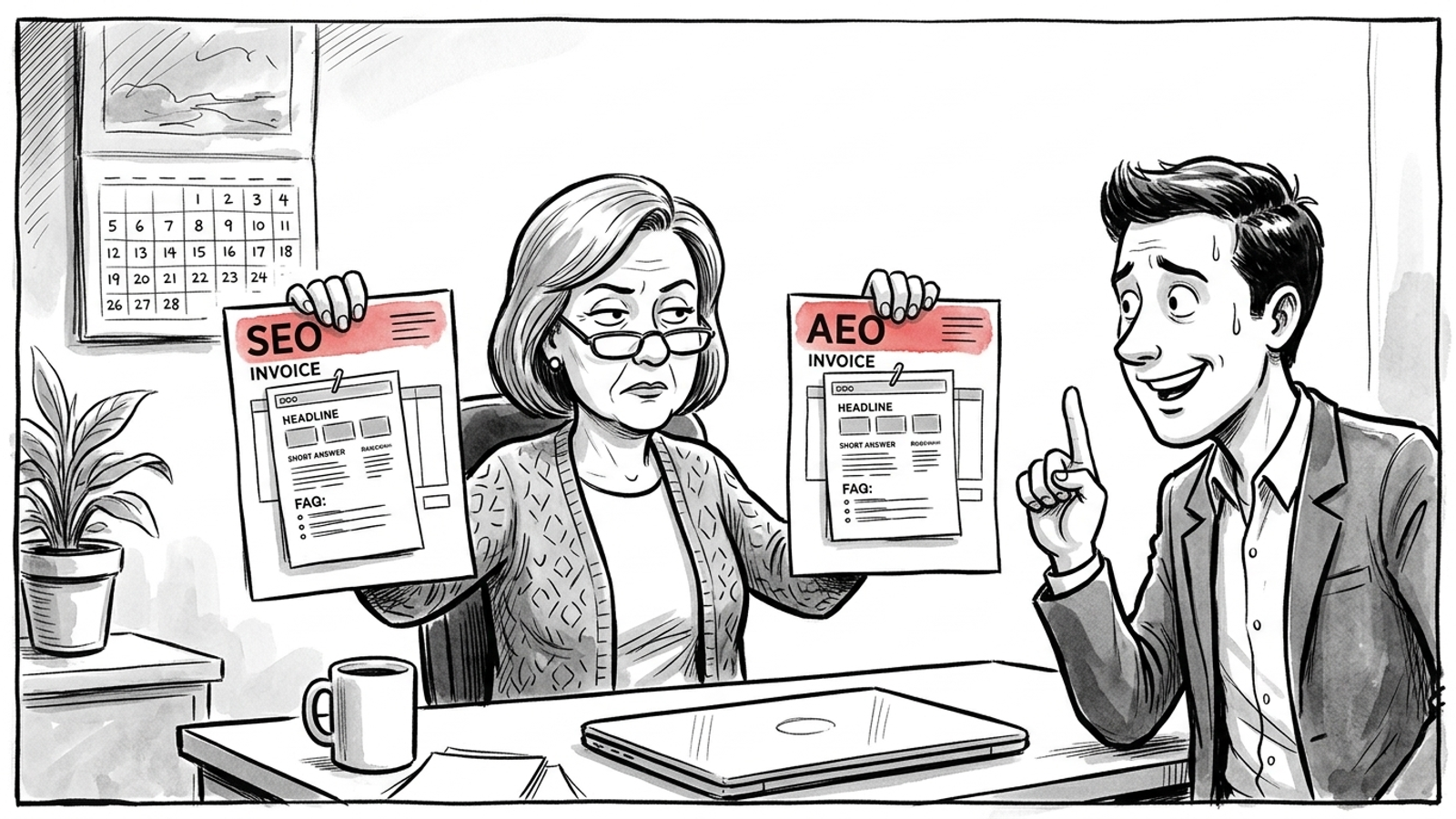
An agency can add a $2,000 AEO line to a $2,500 SEO retainer and still end up rewriting the same service page twice on the invoice. Or it can fold AEO into SEO, absorb daily prompt monitoring and citation work, and wonder where the margin went. Should agencies sell AEO separately, or is that old pricing dressed in a new acronym? Smart people disagree because the buyer’s fear of disappearing from AI answers is real, and so is the overlap with work that buyer already pays for.
I’ll argue each side at full strength, then run the recurring software cost at 5, 10 and 15 client domains. The question isn’t whether the acronym deserves a price tag. It’s what it costs to deliver citations that move, and what a client will keep paying for.
Position A: AEO has work an SEO retainer never scoped
The best case for a separate retainer starts with the task list, not a slide about the future of search. I used to think answer-first content covered AEO. I was wrong. An SEO program can improve a page without telling you whether ChatGPT, Gemini or another answer engine cites it for the prompts a buyer actually asks.
One AEO pricing analysis contrasts SEO’s 12-to-18-month methodology cycle with prompt answers across 5 to 7 platforms that shift every 60 to 90 days. The platforms can cite different sources for the same question. On that account, the added scope has four parts:
- Monitor prompts, with daily refreshes rather than an occasional ranking check.
- Seed citation sources on third-party sites, not just improve the client’s pages.
- Test across engines instead of treating one answer as the whole market.
- Update the method as the platforms change what they surface.
The same analysis prices each driver at $500 to $1,500 per month and puts standalone AEO retainers at 2 to 3 times SEO. I wouldn’t copy that multiple onto every proposal. I would, however, make a client who wants those four jobs see them in the scope. Hiding them inside an unchanged SEO fee doesn’t make them free.
Published offers show how substantial the work can get. Managed GEO starts at $3,000 per month at one agency and $5,000 at another; growth programs run $3,000 to $8,000, and advanced B2B programs run $8,000 to $15,000 or more. At a $5,000 tier, the comparison is not simply SEO tooling at $200 to $500 plus 30 to 40 senior hours. The AEO version described there includes $300 to $1,500 in tooling, 40 to 50 senior hours, answer-ready content at $200 to $400 per 1,000 words, monthly schema audits and 2 to 4 trade publication pitches. Put all that inside an existing $2,500 SEO retainer and the account has a cost problem. Bill for a distinct scope and the client can see what was added.
There’s also a buyer argument. In many clients’ heads, SEO money is maintenance money. AEO money appears when the CEO pastes a competitor’s ChatGPT answer into Slack and wants to know why their company is missing. One agency comparison puts an agency’s time to first citation at 2 to 4 weeks, against 8 to 14 months for a single in-house hire costing around $194,000 in year one. That comparison won’t predict every account. It does explain why a buyer might approve a distinct target faster than a 20% uplift to a retainer they already think covers search.
Separate reporting gives that target a chance of surviving month three. An SEO report can show rankings and traffic; an AEO report can show tracked prompts, which engines cited the client, which sources they used and what changed after a fix. The distinction matters when the source isn’t the client’s site. Practitioner examples describe Gemini and ChatGPT repeating a backstory from Reddit and Medium instead of the official site, while Semrush found ChatGPT citing pages at Google position 21 or lower through query fan-out. Another title-tag pass won’t, by itself, tell you what happened there.
If I sold AEO separately, I’d make prompts won and citations moved the renewal conversation. A new label is not a deliverable.
Position B: Two invoices for one page rewrite won’t last
Now the case against the separate SKU. I’ve billed SEO hours for years, and most work pitched as AEO still looks familiar: direct answers, sound page structure and authority. Call those things what you like. If the agency already owes the client that work, a second invoice doesn’t create a second job.
Google’s May 2026 guidance, as discussed in this pricing overview, says established SEO fundamentals continue to matter for generative features. That gives buyers a fair question before they approve separate SEO, AEO, GEO and AI Overview fees: which task happens only because they bought the new line item? A practitioner quoted in a review of the field put the objection plainly: “I can’t see how AEO/GEO meaningfully differs from traditional SEO.” The criticism stings because a client can compare the scopes without understanding every acronym.
Say you charge $2,500 for SEO and add $2,000 for AEO. In both monthly reports, the main deliverable is the same service page with a direct answer block and FAQ schema. You can call the second pass answer optimization. The client will call it the same page. That’s the old percentage-of-spend habit I dislike: pricing follows a convenient billing category rather than work the buyer can distinguish.
The market’s own packaging shows the tension. Published AI SEO retainers run 30 to 50% above equivalent SEO at the same tier, while many agencies fold AEO into the standard SEO retainer. Other shops put AEO and GEO under one AI-visibility retainer and layer the work onto existing SEO as budgets grow. None of that proves the extra work is worthless. It suggests that the shared work is hard to sell honestly as two independent services. If the task list is identical, one retainer with a clearer target beats two invoices for one job.
A standalone line also makes a slow-moving metric look like failure. A first citation can arrive quickly; dependable movement across a tracked set of prompts is another matter. AI Overviews appear on about 21% of keywords, concentrated in informational queries. A plumbing client or a SaaS client selling a narrow workflow may see nine prompts sit still while two move. On a separate $3,000 line, that can become a cancellation call in month three. Inside a $5,000 visibility retainer, organic traffic growth can still show progress while the citation work continues toward month six.
That is the strongest argument for folding AEO in: not that citations are imaginary, but that a separate SKU creates separate churn risk for work that often shares its foundation with SEO.
The margin math: a cheap tracker is not cheap delivery
Start with the total. For a book modeled at 200 prompts across 5 engines, checked daily, the cited normalization puts per-prompt tracking at $417 to $974 per domain per month, before content or fixes. That is $2,085 to $4,870 for 5 domains, $4,170 to $9,740 for 10, and $6,255 to $14,610 for 15. Those are recurring software figures, not the total cost of serving the clients.
Here are the listed entry prices and the modeled costs. Keep them separate: a vendor’s cheapest tier is not a quote for that 200-prompt, five-engine workload.
| Tool | Listed price or tier | Modeled monthly cost per domain | What the entry price leaves out | Source |
|---|---|---|---|---|
| Scrunch | Entry tier: $250/year | $417 | The modeled workload exceeds the base tier. | Entry tier and normalized cost |
| Semrush | $99/month per domain for 25 prompts; $60 per extra 50 | $429 | The prompt cap matters, and Perplexity refreshes weekly rather than daily. | Caps, refresh and normalized cost |
| Otterly | Lite $29 for 15 prompts; Standard $189 for 100; Premium $489 for 400 | $638 | Standard covers 4 engines; Claude, Gemini and AI Mode are paid add-ons. An extra 100 prompts costs $99. | Published tiers and add-ons; normalized cost |
| Peec | $95/month for 50 prompts | $795 | Brand plans cover 3 of 6 models; API access is Enterprise-only. | Tier and limits; normalized cost |
| Ahrefs | Entry price not specified here | $974 | Use the modeled workload, not an unspecified sticker price, for this comparison. | Normalized cost |
| Profound | $99/month ChatGPT-only Starter | Enterprise quote required for the modeled workload | Starter covers 1 engine; the 7-day trial covers 50 prompts across 3. API access is Enterprise-only. | Starter limits |
The bill grows where the headline price stops: prompt caps, engine coverage, refresh rate and API access. A $29 or $95 entry tier cannot be read as the price of monitoring 200 prompts on 5 engines every day. Check the per-prompt caps before building a retainer around a screenshot of the pricing page.
Software is only the listed recurring layer in that range. Delivery adds answer-ready content at $200 to $400 per 1,000 words, compared with $50 to $150 for SEO content, plus monthly schema audits, 2 to 4 trade publication pitches for citation seeding, CMS publishing, technical fixes and reporting hours (the line-item discussion is here). Those items vary with the scope; I won’t turn them into a fake universal monthly total. Tracking-only tools leave the agency to do or buy that work. A flat per-domain, done-for-you white-label arrangement changes the calculation by putting content, fixes and citations inside the domain fee rather than treating every task as an added senior hour.
Keep one-off and recurring costs apart, too. The figures above describe recurring software and delivery; they do not establish a one-off setup charge. If a proposal includes one, show it separately instead of quietly using a first-month bill to justify the monthly price.
Cheapest mistake: buying a $29 tracker and calling it AEO delivery. Most expensive mistake: scaling per-prompt tracking to 15 clients, then discovering the recurring software bill is bigger than the retainer increase.
My verdict: sell citations moved, not an acronym
I take Position B on the invoice, but I won’t pretend Position A imagined the work. Prompt monitoring, third-party citation seeding and multi-engine testing need a scope and a price. They do not automatically need their own branded retainer. My deciding consideration is whether the client can see a distinct outcome without paying twice for shared work. Sell one visibility retainer with named prompts, engines and citation targets. Put flat per-domain delivery underneath where it fits.
That choice is for agencies with mature SEO accounts, where existing content and authority can support the added work. One pricing framework puts the efficiency gain on mature accounts with 12-plus months of data at 20 to 30%, and suggests SEO base plus 60 to 80% of a standalone AEO price for bundled scope. Shared authority lowers the delivery burden; the proposal should reflect that rather than charge as if every task starts from zero.
The exception is a new-to-digital buyer with no established SEO program to fold into. There, a separate AEO line can keep scope and billing clear, provided you can state what is tracked and report prompts won. I would not sell it merely because the buyer is anxious about a competitor’s AI answer. Fear may open the conversation; it won’t do the renewal report.
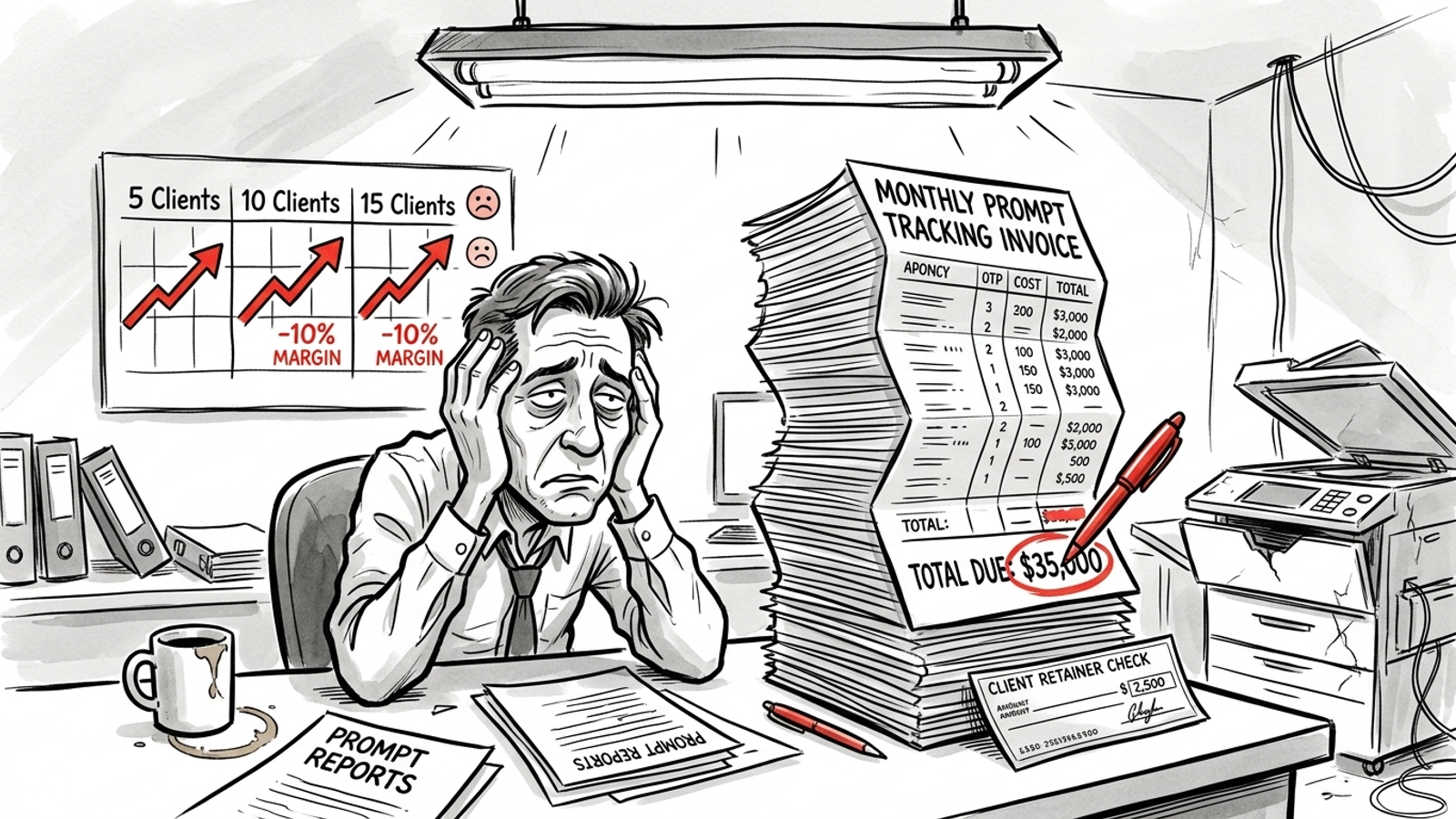
The model matters as much as the invoice. Per-prompt tracking keeps adding cost as the prompt set and client book grow; it does not, on its own, pay for content, technical fixes or citation work. A flat per-domain fee makes those delivery costs easier to plan, though you still have to check what the fee covers. Before signing ten domains, I’d run the 22-check pre-signing list against caps, refresh rates and exit terms.
That is where groas fits my spreadsheet best: white-label, done-for-you execution per domain rather than per prompt, in line with the shift from white-label SEO toward AEO. I’d fold AEO into the visibility offer for a mature SEO book, break out scope when a new buyer genuinely needs the boundary, and price both against an outcome I can report. Skip the new SKU unless you can name the prompts, the engines and the citation target in writing.