

 LinkedIn

Your client grows. Your AEO bill grows faster.
Prompt caps are percentage-of-spend in a new costume. Sign another client, add the queries needed to cover their services and markets, and an Answer Engine Optimization tool can push your agency into a pricier tier before anyone has improved a single page. The vendor counts more prompts. You get the larger invoice.
Picture the ordinary version: a sixth client domain, a regional HVAC business with 32 service subpages and four metro areas. Tracking 80 commercial queries across ChatGPT, Perplexity, Gemini, and Google AI Overviews is not an exotic request. But if your plan stops at 50 prompts, doing the job means buying more capacity. The tool has not written copy, corrected schema, or earned a citation. It has watched a counter cross a line. You could track fewer queries, but then the pricing plan starts deciding which parts of the client’s business you can see. That is a poor substitute for deciding what the work requires.
I have seen this pricing logic before. In paid search, agencies called it percentage-of-spend: fees rose as clients put more money into the account, whether or not management got harder or results got better. In AEO software, the meter reads prompts, keywords, answer credits, or domains instead of ad dollars. The effect on an agency is familiar. The more client work you take on, the more of your margin the meter claims.
Percentage-of-spend taught us the wrong lesson
For years, paid-search agencies defended taking 10% to 20% of a client’s ad budget. The argument was that a bigger budget meant a more complicated account. Sometimes it did. It did not follow that the agency should earn less for cutting waste.
Take a client spending $50,000 a month on Google Ads. If careful negative-keyword work, pruning non-converting broad match terms, and tighter targeting let an agency bring that down to $32,000 while holding lead volume steady, a 15% management fee falls by $2,700 a month. Let the same account burn an extra $20,000 on junk clicks and the fee goes up. As Ryze.ai’s analysis of agency pricing notes, percentage-of-spend aligns fees with budget inflation rather than efficiency.
That is the lesson AEO vendors should have taken from the old model. Instead, some have borrowed the part where the seller gets paid more as the buyer’s activity grows. The units look more technical now, which can make the charge feel less arbitrary. A prompt is still a unit of observation, not a measure of how much strategic work the vendor has taken off your hands.
A client wants to track its brand, three service categories, and five competitor comparison queries across four AI models. Fine, until the account hits a prompt ceiling. The client opens a second location or wants to compare its visibility in Perplexity and ChatGPT. Another tier. The vendor’s automated system runs more checks; your agency still has to decide what the answers mean and do the work that changes them.
When citations drop, the software company is not on the call explaining the missing organic pipeline. You are. Then you may need extra diagnostic queries to find the cause, which can mean paying the vendor more to investigate a problem it merely reported. The vendor earns on the count; the agency owns the outcome. Do not confuse those incentives.
The prompt meter is not the work
Vendors can reasonably say that querying AI engines, storing responses, and maintaining software cost money. Of course they do. But a tracked prompt is not a miniature consulting engagement. At its simplest, the platform sends a query, reads the answer, checks for a brand or URL, and records the result.
The published rates give a sense of the gap between that operation and the price of a tracking allowance. The Perplexity Sonar API pricing lists web-search-grounded requests at $5 per 1,000 queries, plus token fees. explainx.ai’s GPT-4o-mini calculation puts an additional response check at around $0.0006 per prompt. For Google AI Overviews checks through dedicated SERP endpoints, Keirolabs’ benchmark gives a range of $0.10 to $1.00 per 1,000 queries. Those are input costs, not the whole cost of building and operating a product. They still make it hard to pretend every extra tracked prompt demands a leap to an enterprise contract.
A daily check across three engines might cost roughly two cents in underlying query and processing fees, or around sixty cents over a month. An effective retail charge of $2 to $4 per tracked prompt per month buys more than compute. What, exactly, does it buy? If the answer is another row in a chart, the cap looks less like protection against runaway infrastructure costs and more like a pricing lever. I am not asking a vendor to charge only its query cost. I am asking it to explain why the agency’s need for a fuller picture should trigger a much bigger bill when the work after that query still belongs to the agency.

Now give an agency ten client domains, each needing 50 prompts for brand, services, and local comparisons. That is 500 prompts checked daily. On those rough economics, the vendor’s aggregate token and scraping fees come in under $300 a month, while agency-facing tiers for that coverage can run from $990 to $3,900. I would pay for software that removes work. I would be much less eager to pay that spread for permission to count it. The distinction matters most when the agency grows: the same fee structure repeats across every client that needs enough coverage to be useful.
Three ways the meter catches an agency
The entry-tier prompt cap is the first trap. A small allowance can cover a brand name and a handful of obvious questions. It runs out when you try to see how a business appears across products, locations, and buying-stage queries. AEO Labs’ Semrush pricing breakdown describes a $99-a-month standalone AI Visibility Toolkit with 25 tracked prompts per domain; larger allowances sit in Semrush One plans priced from $165.17 to $455.67 monthly. WorkDuo’s breakdown of Peec AI lists an €89 starter tier with 25 prompts across three models, then €199 for 100 prompts and €499 or more for 300. Naridon’s Otterly AI analysis describes a $29 Lite tier with 15 prompts, a $189 tier with 100, overage packs, and separate engine surcharges. The numbers differ; the staircase is the point.
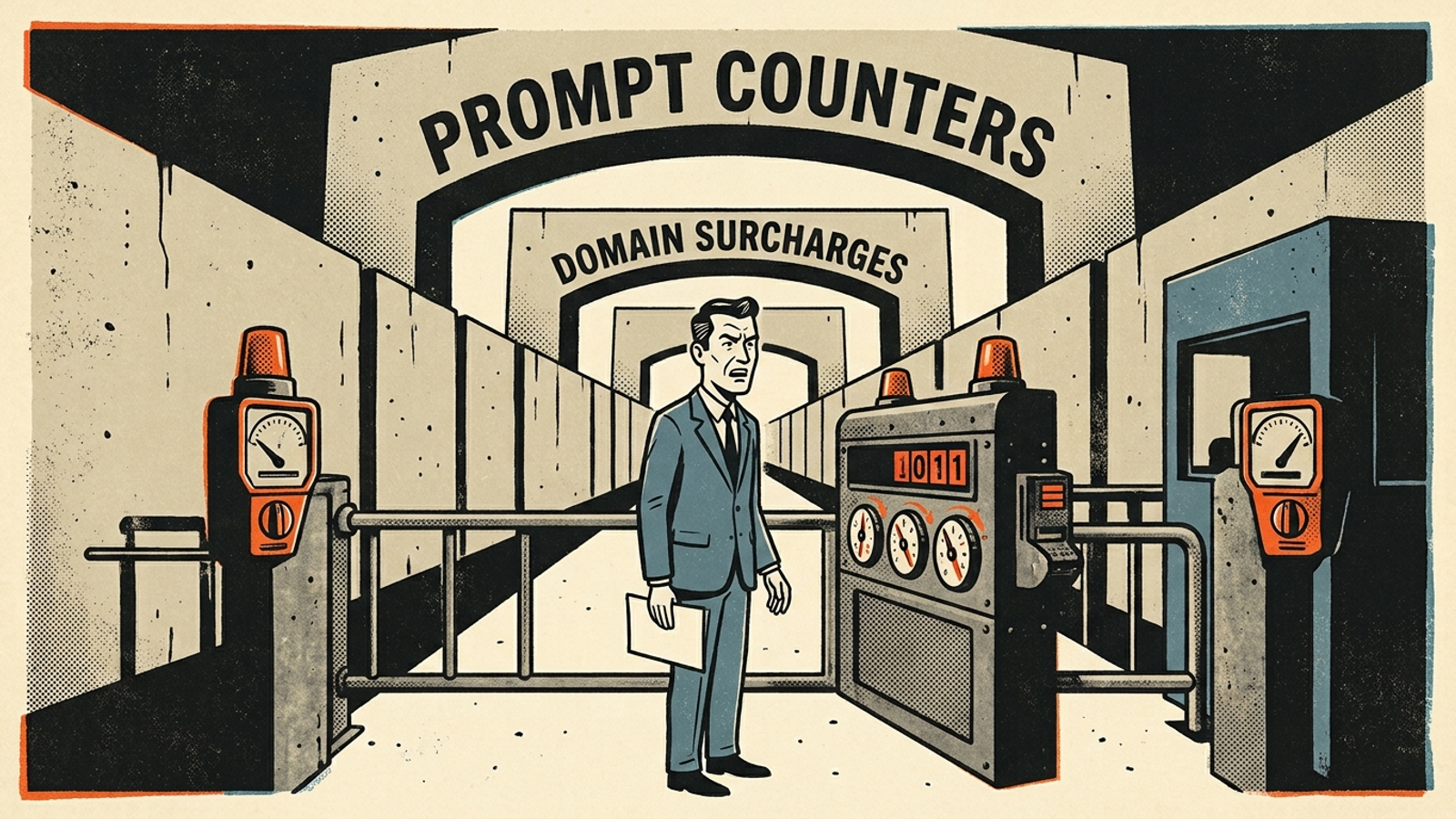
The answer-credit conversion is the second. Rename a prompt check a credit, then make one credit mean one answer from one model. As SearchBrand.ai’s tool comparison explains, 50 prompts checked across four engines consume 200 credits a day, or 6,000 in a 30-day month. “Thousands of credits” sounds generous until you do the arithmetic for one client. Now an account manager is reconciling a proprietary currency instead of improving visibility. I have done enough spreadsheet work for one career; I do not need a new unit for division.
The per-domain or per-workspace fee is the third. It follows the agency as it signs clients, even if each new account needs the same basic monitoring. Rework’s agency cost comparison puts ten domains at about $990 a month with Semrush at $99 per domain, versus $3,990 with Profound at $399 per workspace. At 25 domains, those figures rise to $2,475 and $9,975. Nearly $10,000 a month for the latter arrangement, before your team writes content, fixes technical problems, or builds authority.
That is an expensive way to learn that a dashboard spotted a missing citation.
The small shop can shrug. The growing one cannot.
If you run a boutique agency with two clients, no plan to add a third, and retainers large enough to absorb the software bill, this rant probably is not for you. If one client pays $15,000 a month and an AEO subscription moves from $89 to $400, you may reasonably treat it as overhead and get back to work.
I am talking to the agency building a roster of ten, twenty, or fifty domains across home services, regional medical practices, or multi-location B2B. Every new account needs enough queries to see what is happening. You can absorb the rising tier costs and watch retainer margin shrink, or pass along the overages and explain why a client owes more because you asked the software to watch another service area. Neither is an appealing growth plan. Limit the checks instead, and you have a third option that is worse: sell visibility work while deliberately looking at less of the client’s market.
And this is where the meter becomes more irritating than the price alone. A tracking platform can tell you that Perplexity skipped a commercial roofing page or that Claude cited a competitor for a plumbing query. Useful information. But if it stops there, your team still has to diagnose the gap, update the content or schema, and deal with technical barriers. Observation is not execution. Charging by the observation while leaving every fix on the agency’s desk is like charging to point at a leaking roof and leaving the shingles in the driveway.
Run this billing test before you sign
I want one change: price the work, not the counter. For an agency scaling search and AEO delivery, that means asking what the fee covers and whether a new client or useful query triggers another toll. groas’s agency offering is built around flat per-domain economics without prompt limits, keyword caps, or engine surcharges. Its specialized autonomous models execute search work continuously, with a named human strategist responsible for direction and accountability, rather than handing the agency another passive chart. If you are comparing vendors, use this filter before handing over a card; The Agency AEO Checklist goes deeper on the technical and operational questions. Do the arithmetic against the roster you intend to serve, not just the one that fits neatly into a starter plan today.
- Price meter: Is the fee flat per domain, or does it rise with prompts, queries, or answer credits? Multiply daily checks by engines and days before accepting a credit allowance.
- Engine access: Are ChatGPT, Perplexity, Claude, and Gemini included, or billed as separate add-ons?
- Execution: Does the fee cover fixes and updates, or only charts showing missing citations?
- Scale: What is the actual monthly invoice at 10, 25, and 50 client domains?
- White-label reporting: Can clients see your agency’s reports without vendor branding or login prompts?
- Contract: Is it month-to-month, or does agency pricing require an annual commitment?
- Human accountability: Who takes responsibility for strategy when the tracking finds a problem? Skip this, and your team inherits the diagnosis and execution hours the subscription did not cover.
Stop renting the counter
Percentage-of-spend should have taught agencies to reject pricing that rises for the wrong reason. The AEO version asks you to pay more as clients add service queries, enter new markets, or simply need a clearer view across engines. The vendor gets a larger invoice. Your agency gets the work.
Demand predictable per-domain pricing and execution that can act on what the tracking finds. Otherwise you are not buying an operating model. You are renting a counter that charges extra when your clients grow.