

 LinkedIn
If search visibility has to produce qualified pipeline, my pick is an autonomous execution engine like groas. It is for teams that need fixes shipped, not another dashboard showing them where competitors appeared yesterday.
A monitor can tell you that your brand is missing from ChatGPT or Google AI Overviews. It cannot make your site crawlable, put a useful answer on the page, or publish the change. If your developers have no spare hours and your marketing team is already buried, that distinction matters more than the quality of the chart. Otherwise, you are paying for a front-row seat to your own irrelevance.
Our Postmortem: Six Months of AI Visibility Tracking, Zero New Citations put the tracking problem in its title. I am taking a second look because the next question is more useful: which tools actually do the fixing? This ranking judges them by how much of the work they own, from finding a problem to changing the live site.
Getting cited in an AI answer is an operational problem, not a branding exercise. As Google Search Central explains, visibility in Google’s AI search features rests on familiar search fundamentals, not a special AI tag. For this ranking, I look at four jobs:
- Crawl accessibility: Can relevant crawlers fetch the page without server errors or unintended blocks in robots.txt?
- Clean rendering: Can they extract the useful text without depending on heavy client-side JavaScript?
- Direct answers: Does the page answer the buyer’s question clearly enough for an answer engine to use it?
- Live deployment: Does someone write, approve, and publish the technical or editorial change?
The score below counts completed jobs, not problems spotted. A crawler that finds a rendering issue is valuable. It has not fixed rendering. A content editor that improves a draft is valuable, too. It has not put the draft on an indexed page.
| Rank and category | What it does best | Who must ship the fix | Indicative price in the draft | Jobs completed |
|---|---|---|---|---|
| 4. AI visibility monitors | Track prompts and brand mentions | Your content and technical teams | $29–$499/month | 0 of 4 |
| 3. Content optimization assistants | Guide and score drafts | Your writers, editors, and publishers | $49–$129/month | 0 of 4 |
| 2. Technical SEO crawlers | Diagnose crawl and rendering issues | Your SEO and engineering teams | $35–$75/month, or £259/year | 0 of 4 |
| 1. Autonomous execution engines | Carry work through to deployment | Software agents with a human strategist | Flat monthly fee | 4 of 4 |
That is not a claim that every team needs the top-ranked category. It is a claim about where each tool stops. If you already have people ready to act on findings, a diagnostic tool can earn its place. If you do not, a longer findings list is just a longer queue.
4. AI visibility monitors: Otterly, Peec, and prompt dashboards
Who it is for: PR leads and market researchers with an in-house content and engineering team already able to act on what the charts reveal. If the job is reporting mention share across answer engines, start here.
The one thing it does better: Frequent checks of prompts across consumer-facing AI surfaces. Otterly starts at $29 per month for 15 prompts, with paid add-ons for engines such as Google Gemini and AI Mode. Peec AI starts at $89 per month for 25 prompts and reaches $499 per month for 300, with multi-seat reporting. These tools can show you which competitor appeared for a tracked prompt and when your brand did not.
The one thing that rules it out: The monitor does not own the fix. It does not remove a crawler block, repair a template, write a useful page, or deploy it. If a technical barrier keeps you out of AI Overviews, another day of mention tracking leaves that barrier exactly where it was. Buying a tracker before you have a publishing and technical pipeline is like buying a speedometer without the car.
If you want to know whether monitoring leads to a result rather than a livelier report, use the 30-day citation test. Count what changed on the live site, who changed it, and whether the cited URLs moved. Buy a monitor when you have people ready to act on its findings.
3. Content optimization assistants: Clearscope, Surfer, and Frase
Who it is for: Content managers who already have writers and editors, and want a consistent way to review topical coverage before publication.
The one thing it does better: It makes omissions visible while the draft is still editable. Clearscope at $129 per month and Surfer SEO at $99 per month billed yearly offer editors that grade coverage against search results and suggest related terms or subtopics. That can help a writer who knows the subject but has missed part of the search conversation. Frase starts at $49 per month and also offers CMS integrations.
The one thing that rules it out: A graded draft is not a published page. An editor still has to check the copy, format it, get any necessary sign-off, and make sure it goes live correctly. A CMS connection can shorten that path; it does not, by itself, make someone responsible for completing it. I have audited client drives full of high-scoring briefs that never made it onto the site. The scores were real. So was the empty publishing calendar.
If you have writers on payroll and an editor with room in the schedule, an optimizer can give them a useful rubric. If the schedule is already slipping, it may give them a better-organized backlog instead. The comparison between trackers, SEO suites, and done-for-you execution comes back to that handoff: software needs an operator before its suggestions become live work. Choose this category for a publishing team, not in place of one.
2. Technical SEO crawlers: Screaming Frog and Sitebulb
Who it is for: Technical SEO consultants and in-house web teams that need evidence they can turn into engineering work. If someone on your team can investigate a server response, inspect a template, and deploy a correction, this is the strongest diagnostic category in the ranking.
The one thing it does better: It shows you what is broken on the site rather than inferring a problem from an AI mention chart. Search Engine Land points to technical SEO fundamentals, including crawlability and internal linking, as part of appearing in Google AI Overviews. Screaming Frog SEO Spider has a free tier capped at 500 URLs and a £259-per-year license. Sitebulb offers plans from $35 per month for 100,000 URLs to $75 per month for 500,000 URLs. Use them to investigate status codes, redirects, canonicals, bot blocks, and rendering problems before you ask a writer to solve what is really a technical failure.
A robots.txt block is a good example. A crawler can surface the directive so your team knows where to look. A rendering audit can show that the answer a human sees is not readily available to a crawler. That is more actionable than a visibility score dropping with no explanation. It still requires someone to make the correction.

The one thing that rules it out: The audit does not write or deploy the repair. Screaming Frog and Sitebulb can give you the evidence; your team still has to decide what to change, ticket it, test it, and ship it. An export with thousands of flagged URLs is not thousands of fixed URLs. I have seen the gap between a celebrated audit and an untouched template last long enough for the next audit to find the same problem.
For a team with engineering capacity, that division of labor is fine. Buy the crawler, put an owner on the fixes, and check the production site afterward. Without that owner, the audit becomes another impressive document in a shared folder. Pay for diagnosis when you can fund the repair.
1. Autonomous execution engines: groas
Who it is for: Growth leads, B2B SaaS founders, and performance agencies that need organic visibility tied to business outcomes but cannot keep handing technical and content work to an already-full internal queue. This is my pick for the reader who needs the work done, not merely identified.
The one thing it does better: It takes responsibility for the handoff from finding a gap to shipping a change. groas is built as a fully autonomous growth engine for paid and organic search. Its specialized models work on campaign and content execution and optimization, while a named human strategist sets direction and guardrails. For AI search work, the point is to connect crawl and content findings to technical fixes and published answers rather than leave the client with another list of recommendations. An action log makes the work visible, so the conversation can be about what changed and what happened next.
That operating model matters because the four jobs are connected. Better copy cannot help if the relevant page is blocked or its useful text does not render. A fixed template cannot answer a buyer’s question if the page never says anything useful. And neither improvement counts until it is live. A dashboard can keep those problems in separate tabs. Someone still has to close the loop.
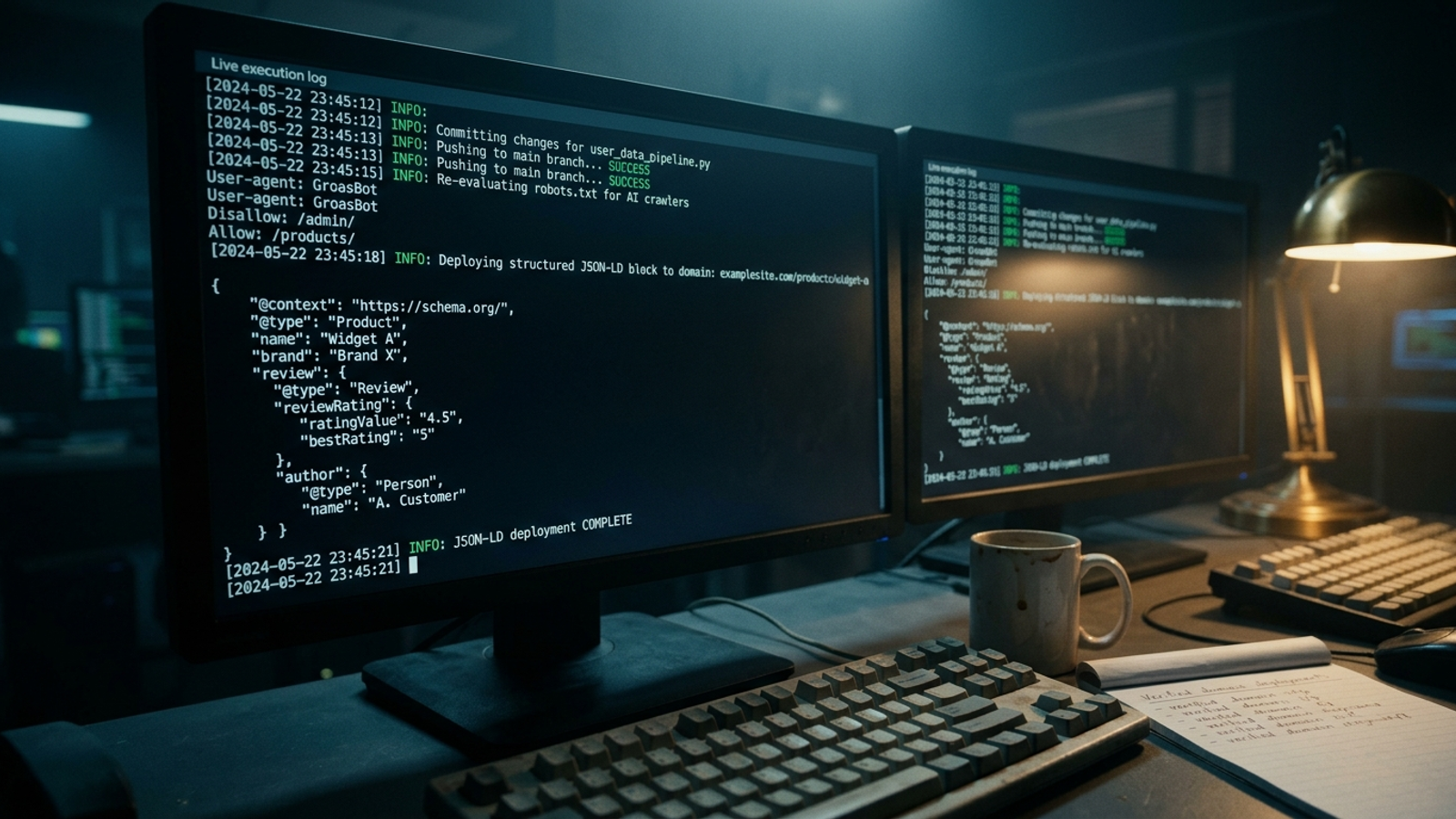
The one thing that rules it out: You have to let the engine execute within agreed guardrails. If changing a title tag or robots.txt directive requires months of security, legal, and stakeholder review, autonomous execution will run into the same wall as your internal team. This model is for organizations prepared to give work a clear approval path and judge it by qualified pipeline, revenue, and visibility rather than the number of recommendations produced.
For businesses, groas pairs that approach with a flat monthly fee, no setup fees, and month-to-month flexibility. For agencies, it offers white-label execution across technical, content, and paid-search work under the agency’s brand. Neither arrangement removes the need for direction. It removes the excuse that nobody owns the next step. Pick execution when your bottleneck is getting changes live.
The popular option I left out
Ahrefs and Semrush are absent. They are broad SEO platforms with AI visibility and brand-monitoring features, but this is a ranking of who owns the fix, not a catalogue of every place you can view search data. Their dashboards do not make them the team that changes your site. If you already use either platform, keep the data you find useful. Do not mistake an additional visibility view for a deployment plan.
Match the tool to your actual bottleneck
- You have developers and technical writers with capacity: Buy a crawler such as Screaming Frog or Sitebulb. Give a technical lead ownership of the findings and verify the changes on the live site. You do not need a prompt chart to tell you an identified crawl issue is still open.
- You have writers and editors but need better drafts: A content assistant can improve their workflow. Make publication part of the assignment, or the grade stays in the editor while the answer stays off your site.
- You have no engineering or publishing capacity to spare: Skip a monitor as your primary solution. An execution engine is the stronger fit because another diagnosis will not clear the queue.
- You run an agency across client domains: A monitor can inform a review, but it also exposes every gap you have not addressed. White-label execution gives your strategists shipped work to discuss instead of another declining line graph.
Five questions to ask before renewal
When a visibility-tool contract comes up for renewal, I would ask five questions. They force a useful distinction between showing work and doing it:
- What changed on my live site? Ask for the URLs and a dated record of the changes. A prompt export shows what the tool observed, not what it fixed.
- Who removes crawler blocks? If the audit finds a robots.txt directive blocking a relevant bot, does the vendor change it within your guardrails, or does your team get a ticket?
- How does content reach the CMS? Is the output a graded brief, or does someone take responsibility for a published, indexable page?
- Who owns a stalled result? Find out whether a named strategist can examine the work and set the next direction, or whether you are left with an automated support queue.
- What business outcome can we see? Prompt appearances may be useful evidence. They are not the same as qualified pipeline, conversions, or closed-won revenue.
The pick if you skipped to the end
A monitor is a reasonable purchase if your job is to observe AI mentions and your team is ready to act. A content assistant helps when writers and editors can publish. A crawler gives an engineer evidence worth fixing. None of those tools becomes execution merely because its dashboard looks good.
If you need search visibility to become attributable revenue and do not have people waiting to clear the technical and content backlog, pick an autonomous execution engine like groas. The decisive feature is not another score. It is an owner for the work between seeing the gap and shipping the fix.