

 LinkedIn

Your brand can appear in an AI answer and still lose the citation to a review site. So what gets you linked: a better page on your own domain, or more people talking about you elsewhere? Smart people disagree because both camps can show results. One says AI engines need a clean passage they can quote. The other says that, when a buyer asks whom to trust, engines listen to the rest of the web. Both think the other is burning your budget.
I spent years fixing Google Ads accounts where a similar fight played out over Quality Score. I used to tell clients it was all about the landing page. I was wrong. Or half wrong, which in this business is the same thing. I am not giving you a hedged do-both list. I will argue each side as its best advocate would, then rule by prompt type and give you a way to check which camp your business is in.
The question behind an unlinked mention
Ask ChatGPT for the best CRM for a 12-person real estate team and you may get named in the prose but not linked. A mention puts you in the answer; a citation gives the reader a path to your site. In one practitioner tracking loop, buyer prompts cite G2, Reddit and a competitor comparison while the brand sits in the text unlinked. That gap is the fight.
Position A says you can close it on your domain: write the quotable passage, let crawlers read it and keep it current. Position B says buyer-prompt citations are decided on pages you do not control, because engines look for outside agreement. The source pool varies by engine, too: Google AI Overviews run on the Google index, ChatGPT on Bing plus its own crawler, and Claude largely on Brave. With only two to seven citation slots per answer, the next dollar needs a destination.
Position A: Make your own pages worth quoting
If I am arguing for the on-site camp, I start with retrieval. AI engines do not just choose a page and cite it. They pull passages that answer parts of a question. Google fans a query out into background searches, then looks for a clean chunk that answers one of them. In Ahrefs’ March 2026 pull of 863,000 keywords, only 38% of AI Overview citations ranked in the top 10 for the main query; 31% sat beyond position 100. A page can miss the main-query rankings and still supply the useful answer.
The practical version is blunt: phrase each H2 as the user’s question, put a 40-to-60-word self-contained answer beneath it, and include a standalone definition or list when the subject calls for one. I have seen this work the way negative-keyword mining works. Boring, mechanical, and it moves the number. Give the engine a passage it can lift without reconstructing your argument.
Then check whether it can reach that passage. Otterly’s trawl of more than 1 million citations across ChatGPT, Perplexity and AI Overviews found 73% of sites had a technical barrier, including robots.txt blocks, CDN user-agent rules and JavaScript-only rendering. A leftover nosnippet directive, a restrictive max-snippet value, facts trapped in images or tabs, or a block on Googlebot can take you out of contention before ranking signals matter. You cannot be quoted if the crawler cannot read you. Fix the plumbing, then write the passage. For the fuller sequence, I use the passage-first method for AI citations: crawl check, direct answer, cleaner HTML, dated test.
A’s strongest evidence: structure and freshness
The on-site camp has more than a tidy theory. AirOps data reported through Search Engine Journal found that sequential headings correlate with 2.8x higher citation likelihood; 61% of cited pages use three or more schema types; and around 80% of ChatGPT-cited pages include lists. Google’s own May 2026 line says you do not need special AI schema or llms.txt. Fine. The useful point is that clear structure makes an answer easier to extract, not that another markup file will save a weak page.
Freshness gives this camp another job it can actually do. Pages untouched for more than three months are 3x more likely to lose citations, and more than 70% of cited pages were updated within the last year. You own the page. You can keep its answer current. Before you buy attention elsewhere, make sure your best answer is readable, extractable and maintained.
Position B: Let the rest of the web make the case
Now I switch jerseys. For best X and comparison prompts, the engine is not looking for your description of yourself. It wants someone who compared five options and lived to write about it. AirOps found 85% of brand mentions come from external domains, brands with strong off-site presence are 6.5x more likely to earn visibility, and about 90% of third-party mentions originate from listicles, comparisons and review roundups. For these prompts, your sales page is an interested party. What the deck calls authority building, I call getting talked about by people who are allowed to dislike you.
The off-site camp’s best argument is outside agreement, not prettier copy. About 48% of AI search citations come from community and user-generated platforms such as Reddit, YouTube, LinkedIn and Wikipedia. The mix changes by engine. In the US, YouTube leads AI Overviews at 22.9% against Reddit’s 18.5%, while Reddit leads ChatGPT, Gemini and Perplexity. A buyer asking Google may see video; one asking ChatGPT may see threads. If your brand has no footprint in either, your homepage is arguing with an empty chair.

Consistency is the part this camp gets right and most businesses skip. When specs, certifications or service areas conflict across directories, AI may leave the brand out rather than guess. Audit your top 10 third-party results before chasing new mentions. An Ahrefs study of 75,000 brands found unlinked brand mentions correlate at 0.664 with AI Overview visibility, against 0.218 for backlinks. The author flags correlation, not causation. Fair. But the practical case remains: for buyer prompts, check what outside sources say about you before you commission another page about yourself.
Where each argument goes too far
Position A oversells control. Clean passages, sequential headings and schema can improve your odds, but they cannot force a citation when someone asks who is best. One academic sweep of 167,551 citations found 85.7% pointed to third-party sites against 14.3% to brand-owned pages. That is what you would expect when an engine is asked to recommend a vendor and does not take the seller’s word for it. I learned the limits of a good landing page running lead-gen: it still lost when review sites disagreed on price and service area. Fix your page first, but do not expect it to outvote the room.
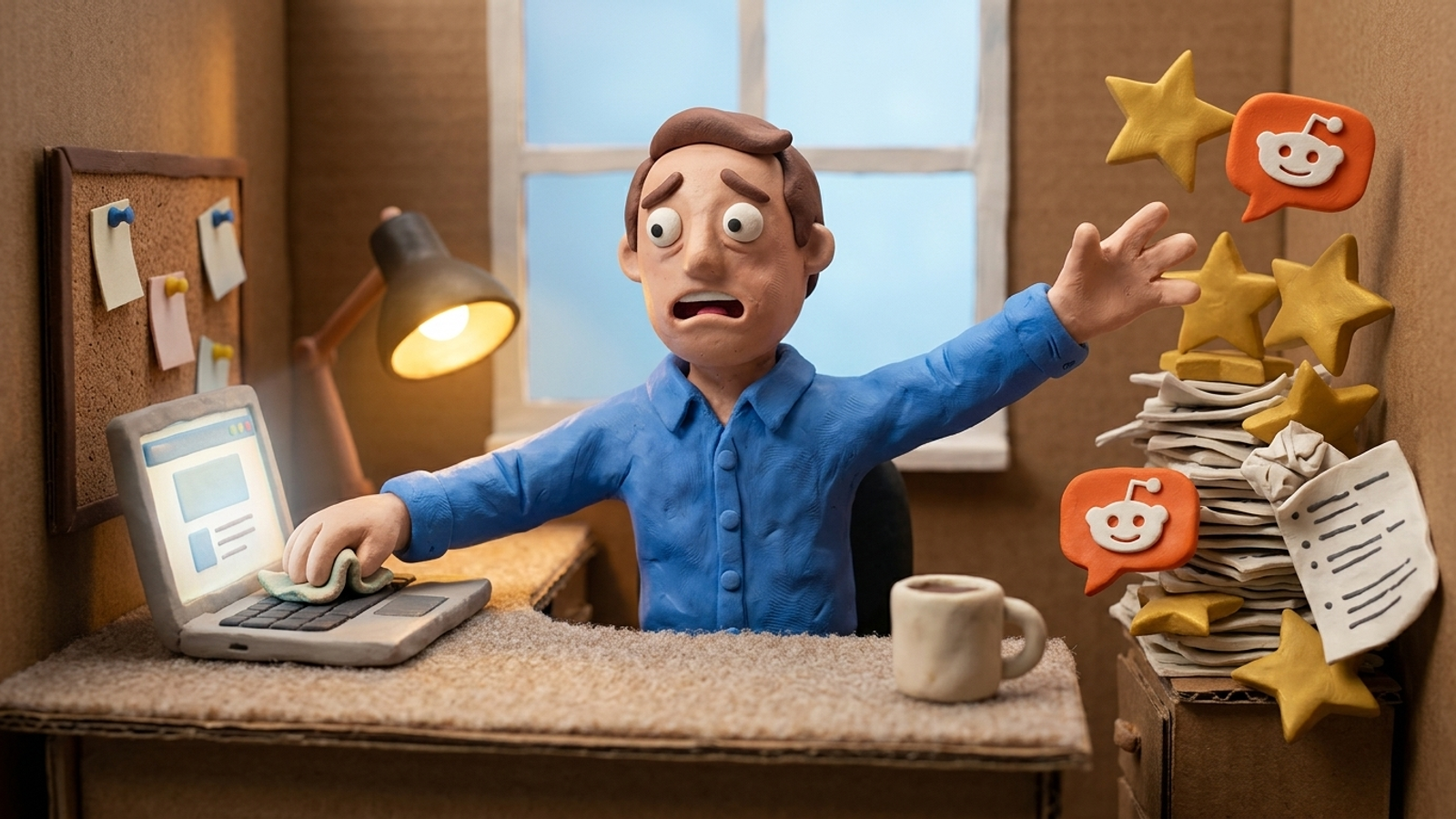
Position B oversells consensus in the other direction. Mentions correlate; they do not compel. Google has never confirmed unlinked mentions as a ranking signal, and the oft-cited implied-link patent is not proof of production use. That 0.664 correlation is useful direction, not a lever you pull. My rule: if your categories, hours and specs disagree across the top 10 third-party results, stop buying new mentions and fix the facts. Consensus without consistency gets you ignored.
Run a content-gap check before you spend
Stop guessing. Build a set of 40 to 80 prompts across branded, category, comparison, problem and integration questions. Run them in fresh sessions. For each answer, log whether you appear, whether you get cited, the cited URL, the source type and the sentiment. That is the tracking loop community testers recommend. Keep the same set for your follow-up; otherwise you are measuring a new question and calling it progress.
Say you spend $20k a month and run 60 prompts. If you appear in informational answers but vanish in buyer answers, another rewrite is unlikely to solve your main problem. Look at outside agreement. If you are absent from both, start with the pages and the crawl path. The engine matters here: brand domains capture 52.5% of citations overall, but 59.8% in Google AI Overviews against 44.7% in ChatGPT and 28.9% in Perplexity. Do not treat one screenshot as a universal verdict.
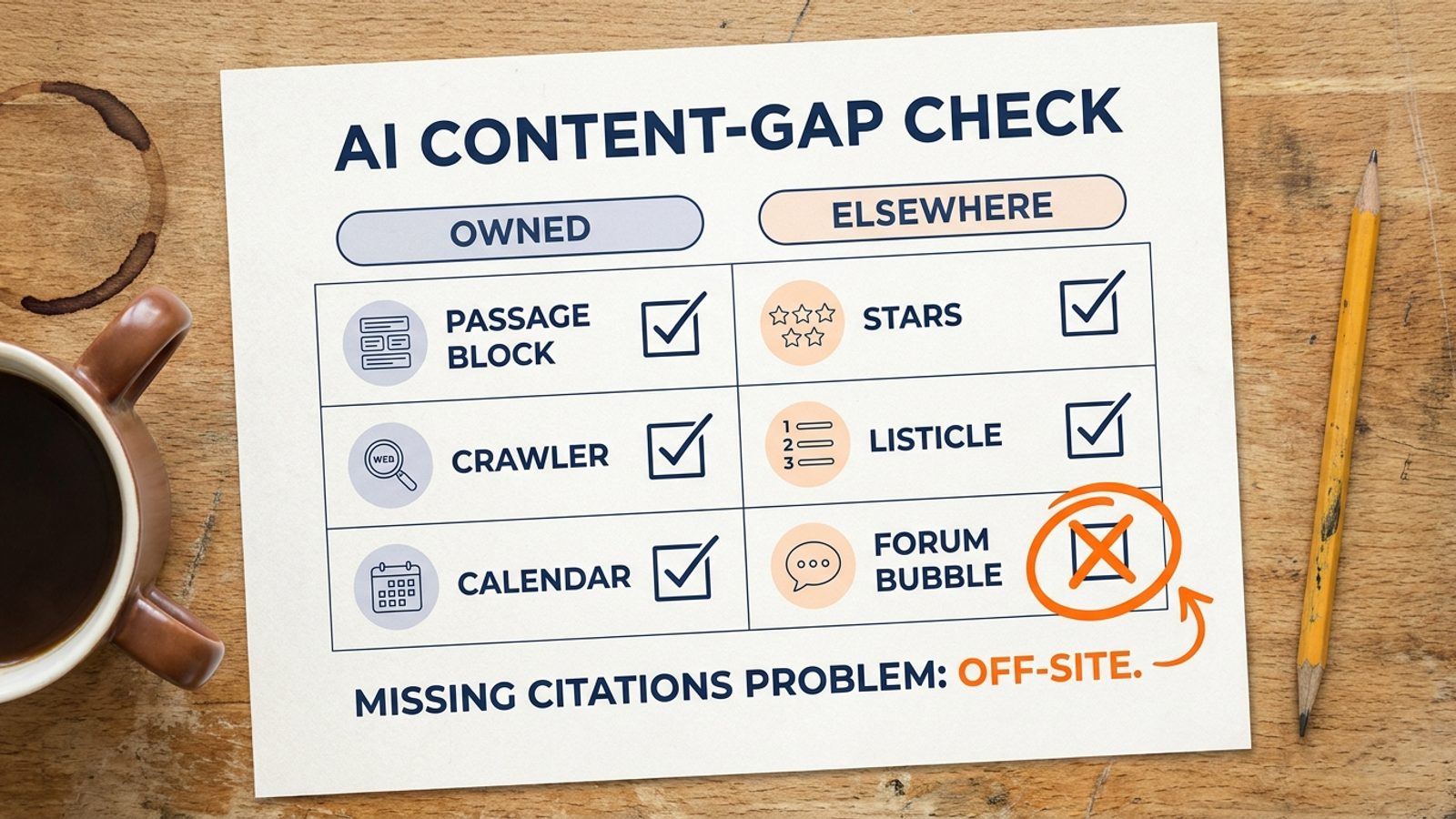
Work the diagnosis in order:
- Crawl. Can GPTBot, OAI-SearchBot and Googlebot fetch and render the relevant page without a login, a block or JavaScript-only text? If not, fix that before debating content.
- Passage. Does each important question have a direct answer, a useful definition and, where appropriate, a list? If the answer is scattered across the page, there is no clean quote to lift.
- Freshness. Has the page sat untouched while the answer changed? Pages stale beyond three months are 3x more likely to lose citations. Check the substance, not just the date stamp.
- Consensus. Do your top 10 third-party results agree on your services, areas and specs? A mention plus citation brings 40% higher reappearance odds but occurs in only 28% of answers. Track mentions, but do not mistake them for the click.
The pattern across prompt types tells you which constraint to work on next. The checklist tells you what might be blocking it.
My verdict: let the prompt decide
I take Position A for informational prompts and Position B for buyer prompts, once basic crawlability and factual consistency are fixed. The deciding consideration is what kind of trust the question asks for. A what-is question needs a clear explanation. A what-to-buy question needs evidence beyond the seller’s own page. That is a budget decision, not a polite way of saying “do everything.”
What-is and how-to prompts: A wins
For informational questions, invest in a page the engine can read and a passage it can use: a 40-to-60-word answer, clear headings, a definition and a list when one helps. Maintain the answer as it changes. Google AI Overviews give brand domains 59.8% of citations, against 28.9% in Perplexity, so pay attention to where your audience asks. If you need that view before prioritising, read the comparison of Google AI Overviews, ChatGPT and Perplexity. Own the definitions in your category before you chase someone else’s list.
Best, versus and near-me prompts: B wins after the basics
For buyer and comparison questions, your homepage enters as an interested party. The engine wants a witness. That is why off-domain citations, listicles, roundups and community pages keep appearing in the data. But outside agreement cannot rescue a page the crawler cannot read or facts that conflict across directories. Fix crawlability and consistency; then put your effort into credible third-party coverage. Off-site wins the buyer prompt only when the basics stop disqualifying you.
Business size changes the starting point. If you are a small local-service team living on Google, do not skip the on-site and facts cleanup to chase every forum. If you sell software that buyers compare in threads, do not spend the whole quarter polishing definitions while those comparisons happen without you.
A 90-day split for a small team
If you have one owner and four hours a week, give each stretch of work a job:
- Days 1–30: make your answers usable. Unblock crawlers, clean up snippet restrictions and rewrite the five pages mapped to your highest-value questions. Give each a direct answer, a definition and a list where useful. Check pages that have sat untouched for more than three months.
- Days 31–60: remove contradictions. Align services, areas and specs across your top 10 third-party results. Claim the profiles that feed AI answers. Do not pitch new coverage while the existing coverage cannot agree on what you sell.
- Days 61–90: earn outside mentions. Make one useful YouTube video, answer one thread where buyers already compare options, and pitch one listicle with real specs rather than a press release. Re-run the same 40-to-80-prompt set to see which answers changed.
If informational citations climb but buyer prompts stay dark, keep the pressure off-site. If nothing climbs, revisit the crawl and passage work before declaring that mentions are the answer. Check the cost breakdown for content, technical fixes and off-site authority work before hiring three vendors to do the work in pieces.
Fix your own pages so you can be quoted. Get talked about elsewhere so you get picked. That is why I stopped splitting the job across tools. groas runs both sides as one system, with technical fixes, passage rewrites and citation work executed continuously, actions logged with their reasoning, and a named strategist who owns the outcome. Run the gap check this week. Then put the next 90 days where your prompts say the missing trust is.