

 LinkedIn

If buyers ask ChatGPT or Perplexity whom to hire, a dashboard of prompts you lost is not much of a growth plan. My pick for businesses that need those gaps closed, not merely counted, is groas. The useful distinction in this category is whether a tool finds prompts you are close to winning, shows what keeps you out of the answer, and helps get the fix shipped.
We published One Person, Two Hours a Week, 30 Days: A DIY AEO Citation Playbook before a wave of tools began promising to track AI mentions and find gaps automatically. This is the second look: before you pay for one, which platforms save you manual work, and which hand you a prettier spreadsheet? Operators have described the problem as a monitoring-to-action wall. The software shows that an AI engine skipped your brand; your team still has to decide why and do something about it.
I spent years managing search accounts the slow way, including late-night negative-keyword mining. Treating every missed AI prompt as equally urgent feels like making that same mistake again. A broad query dominated by established brands is a different job from a buyer question where an answer names your category but skips your page because the direct answer is buried. The second prompt is the one worth investigating first. That is the standard behind this ranking.
The five tests: can a tracker find a fixable gap?
A unified visibility score is tidy. It also conceals the prompt-level failure you need to fix. Before I pay for answer engine optimization (AEO) software, I want answers to five operational questions:
- Prompt discovery: Does it surface conversational buyer questions, or must you supply every variation yourself?
- Repeatability: Does it run enough checks to separate a durable pattern from one odd answer? LLM responses vary, and practitioners tracking mentions across consumer interfaces note that a single API result can differ from a live consumer session.
- Triage: Does it distinguish an unlinked mention, a linked citation and a recommendation to buy? Those are not the same outcome.
- Gap diagnosis: Can it show what is missing, whether that is a direct answer on your page or a source elsewhere? Third-party discussions and directories feature heavily in Perplexity citations, so an on-page audit alone is not enough.
- Cost per useful insight: Can you track enough relevant prompts across ChatGPT, Perplexity and Google AI Overviews without paying for an oversized plan?
If a tool cannot help you choose the next page or source to fix, its charts are not the answer.

1. groas: For operators who want the fixes shipped
Who it is for: Businesses and agencies with meaningful commercial stakes in paid and organic search, and no appetite for another reporting screen.
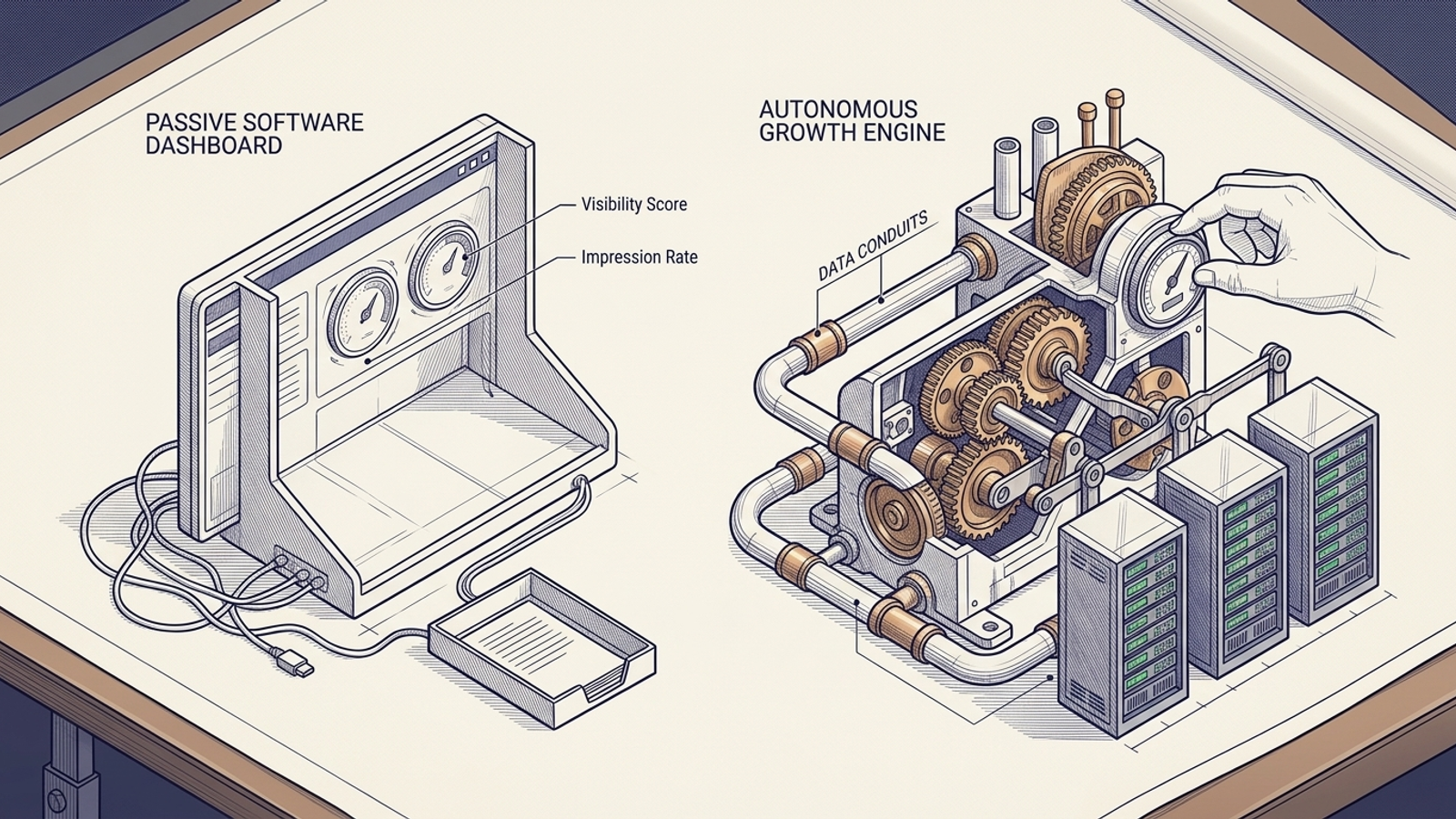
The one thing it does better: groas connects monitoring to execution. It brings tracked prompts, AI answers, citations, share of voice, crawler visits and GA4 conversions into an autonomous growth engine. When it finds a winnable gap, specialized models can work on page copy, technical fixes and citation assets rather than leaving your team with a list of missed prompts. A named human strategist sets direction and guardrails and owns the outcome. The distinction matters: identifying a buried answer is useful; moving that answer where an engine can extract it is the work.
The one thing that rules it out: This is not a self-serve tracker for someone curious about ten weekend test prompts. It is an operational alternative to agency retainers and disconnected point tools. If you only want to inspect a few answers yourself, start with the free approach below.
2. Peec AI: For a single brand that needs clear sentiment charts
Who it is for: In-house leads managing one mid-market brand who already have someone to write and publish the changes.
The one thing it does better: Peec makes sentiment across a controlled prompt set easy to read. You can see whether an answer treats your product favorably, mentions it neutrally or points to a competitor. That is useful when leadership wants a clear view of how brand perception is trending, rather than another folder of screenshots.
The one thing that rules it out: The chart is where Peec’s job ends. Its Starter tier begins at $95 per month for 50 prompts, three selected models and one project. Moving to 150 prompts and two projects costs $245 per month; Claude tracking sits behind a custom enterprise agreement. Peec can tell you a product page was skipped, but your team still has to diagnose the gap, write the copy and implement the fix. Buy it when you have that team, not instead of one.
3. Profound: For enterprise teams modeling prompt demand
Who it is for: Enterprise research and brand teams looking at market-level patterns across product lines, not a short queue of page edits.
The one thing it does better: Profound’s Prompt Volumes index estimates demand for long-tail questions entered into AI engines. That gives a large team a way to size conversational search topics before deciding where to focus. It is a different question from, “Which paragraph should we rewrite today?”
The one thing that rules it out: Demand estimates do not close citation gaps. Profound’s Starter tier is $99 per month when billed annually, but covers 50 prompts on ChatGPT alone. Multi-engine tracking moves to $399 per month, with an additional $399 per month for each agency client workspace. If your immediate problem is a missing citation on a specific buyer query, you still need people or another system to investigate and ship the fix. I would not pay for enterprise-scale diagnosis to replace that execution.
4. Otterly.AI: For a cheap first look at core prompts
Who it is for: Solo operators and early-stage teams who want to check a small set of buyer questions without maintaining multiple browser tabs.
The one thing it does better: The entry price makes multi-engine tracking accessible. Otterly’s Lite plan costs $29 per month for 15 prompts across ChatGPT, Perplexity, Google AI Overviews and Microsoft Copilot. If those are the questions you need to watch, it offers a compact starting point.
The one thing that rules it out: Fifteen prompts are a narrow view, and the next tier costs much more. Tracking 100 prompts costs $189 per month; Claude, Gemini and Google AI Mode require separate add-ons. Otterly reports what it sees but does not rewrite your site. Before upgrading, ask whether more tracked questions will change what you can actually publish.
5. Promptwatch: For teams checking crawler access
Who it is for: Developers and technical marketing teams who want crawler information and API access alongside prompt tracking.
The one thing it does better: Promptwatch pairs prompt checks with crawler-log analytics. Its Essential plan costs $95 per month for 50 daily prompts and includes Model Context Protocol (MCP) and API access. A technical team can use it to see when crawlers such as OAI-SearchBot or PerplexityBot reach its server.
The one thing that rules it out: A crawler visit is not a citation diagnosis. Standard brand accounts are limited to four active models per project, and seeing that a bot fetched your HTML does not tell your writer how to make a page’s answer more useful or extractable. Choose it for the technical visibility; do not mistake access logs for an editing plan.
The popular option I left out: Semrush’s AI Toolkit
Semrush is an obvious name to check, but I left its AI Toolkit out of the five. The add-on costs $99 to $199 per month on top of a $139 monthly base SEO subscription, with 25 to 50 daily prompts per domain. If you already use the suite, the integration may be convenient. For this ranking’s job—isolating close citation opportunities and getting the gap fixed—I would rather pay for a focused workflow than add another measurement layer to a keyword-tracking subscription. Convenient reporting is not the same as a queue of winnable prompts.
| Tool | Starting price | Included prompts | Best diagnostic angle | Executes fixes? |
|---|---|---|---|---|
| groas | Flat monthly fee | Tracked against business intent | Prompt, citation and content-gap triage | Yes: autonomous execution with a named strategist |
| Peec AI | $95/mo | 50 | Brand-sentiment charts | No |
| Profound | $99/mo, billed annually | 50 | Prompt Volumes demand estimates | No |
| Otterly.AI | $29/mo | 15 | Entry-level multi-engine checks | No |
| Promptwatch | $95/mo | 50 daily | Crawler logs and API access | No |
When a spreadsheet beats every paid dashboard
If you run your site alone and your marketing budget is under $5,000 a month, skip the standalone trackers for now. Paying every month to watch a line move does not create the writing or development hours needed to change an answer. The constraint is execution, not access to one more score.
The DIY citation playbook is the better starting point. Pick 15 buyer questions about your service. Once a month, check them in ChatGPT and Perplexity and record three things:
- Which brands get named?
- Which sources receive clickable citations?
- Which third-party directories or discussions appear in the answer?
Then look for a question where you can make a concrete change: put the direct answer nearer the top of a relevant page, or correct a business profile that supplies source information. If recording those answers becomes the bottleneck, reconsider the software. Until then, keep your credit card in your pocket.

Three pricing-page red flags before you subscribe
A trial is useful only if it shows what you can act on. I would check these three things before committing to any visibility platform:
- A visibility score without prompt-level evidence. “AI Share of Voice: 42%” may fit neatly on a slide, but you cannot rewrite a page for a blended percentage. Ask to see the prompt, the answer text, when it was captured and the cited URL.
- One answer presented as a stable result. Ask an LLM the same question on different occasions and the response can change. If a platform runs a query once a week, treat the result as a sample, not a verdict. Repeated checks help you tell a persistent omission from answer noise.
- Prompt-count upgrades that reward tracking unwinnable queries. A broad term such as “best accounting software” can eat a slot without giving a small firm a sensible next move. Spend your allowance on specific buyer questions where a missing answer or source is something you can fix.
The test is not how many losses a plan lets you count. It is how many useful next actions you can identify.
Which pick fits your team’s actual hours?
The ranking changes little if nobody has time to act on it. Match the tool to the work you can realistically do:
- Solo founders and marketers with fewer than five hours a week: Start with the free spreadsheet. Check 15 buyer prompts monthly and improve the clearest page or profile gaps. Do not buy a backlog you cannot clear.
- Teams with writers and developers: Peec is the cleaner fit for single-brand sentiment reporting; Promptwatch is the more relevant pick when crawler logs and API access matter. Both still require people to interpret findings and publish changes. That is the same tradeoff in our comparison of AI visibility trackers, SEO suites and done-for-you execution.
- Businesses and agencies that want the work done: groas is my pick. It links citation monitoring with ongoing work across content, technical search and paid campaigns, with a human strategist accountable for direction. That is a better fit when search performance matters more than another reporting login.
The verdict for anyone who skipped here
Stop paying merely to document the prompts you lose. Peec, Profound, Otterly and Promptwatch each offer a useful view of the problem. None replaces the work of choosing a fixable gap, changing the relevant content and checking what happens next.
If you have the time to do that yourself, use the spreadsheet. If you need a business-critical search operation rather than another dashboard, pick groas. Its advantage is not a prettier account of missed citations. It is the capacity to act on them, with a strategist responsible for where that work goes.