

 LinkedIn

Most agencies will not tell you this: your AEO bill may buy a detailed account of missing citations without buying the work that could earn them. If you run a small or mid-sized business choosing between in-house monitoring, an AEO agency, and a done-for-you platform, compare them on shipped changes per dollar, not monthly price.
I spent years managing search accounts by hand, and I know how easily a useful report becomes a substitute for action. The unit I want to count is a page published, a schema fix shipped, a retrievability problem cleared, or a third-party mention earned. Monitoring can tell you what is missing. A retainer can tell you what to do. Neither gets cited merely for knowing the answer.
First, know what each model sells
In-house monitoring means tools plus your own staff. You buy one or two AI visibility trackers and assign someone to turn the findings into pages, fixes, and outreach. Software runs $29 to $699+ per month, while entry AI visibility plans cluster at $25 to $99 per month. HubSpot’s pricing breakdown lists HubSpot AEO at $50 per month, Profound from $99 per month for Starter and $399 for Growth, and Peec AI from $95 per month. The subscription is the small line item. The person who acts on it is the bill.
An AEO agency retainer means outside strategy and a defined scope of work. Solo consultants charge roughly $150 to $300 per hour for light work, while full-loop retainers run $5,000 to $18,000 per month for strategy, pages, schema work, and measurement. Published tiers include $2,500 starter, $5,000 professional with 30 to 50 tracked queries, and $10,000+ enterprise; a disclosed single-account small-business retainer runs as low as $1,000 per month (AEO tier survey). Mid-market retainers run $8,000 to $25,000 per month. Some agencies execute well. Others sell what the deck calls integrated strategy: a monthly meeting where someone tells your team what to build.
A done-for-you platform sells execution under accountable direction. A platform like groas pairs ongoing search work with a named human strategist who sets direction and guardrails. Content, technical work, and visibility efforts are meant to move without your team translating every chart into a ticket; logged actions let you inspect what happened. That distinction matters more than whether the interface looks impressive. A dashboard can show a missing page. It cannot publish one.
Axis 1: What actually ships?
A monitoring tool tells you where you were not cited yesterday. That is useful the way a scale is useful. It does not lose the weight for you. Many AEO tools function as monitoring systems rather than execution engines, without a content creation or distribution workflow attached (the execution gap breakdown). Lean teams still need to put effort into digital PR, listicles, and attribute-rich schema that can affect citation rates (category tool roundup).
I used to tell clients the dashboard was step one and action would follow. I was wrong. In a small team, nobody necessarily owns the rewrite, the schema fix, or the third-party mention. The chart gets forwarded around. The page stays identical.
With an agency, the question is what the statement of work actually includes. An audit and strategy call may be useful, but they are not published pages. If execution is capped, anything beyond the cap waits for a new scope or a later month. A done-for-you model makes the work, rather than the recommendation, the point of the purchase. Count completed changes, not logins or meetings.
| Model | What the purchase produces | Main bottleneck |
|---|---|---|
| In-house monitoring | Citation data; pages and fixes only when your team completes them | Staff time and follow-through |
| Retainer agency | Defined audits, reporting, and whatever execution the scope includes | Scope caps, approvals, and meeting cadence |
| Done-for-you platform | Ongoing content, technical, and visibility work with logged actions | Direction and approvals where your input is needed |
This table does not promise that every shipped page earns a citation. It tells you who is responsible for putting something into the world that could earn one. That is the first question I would settle before discussing price.
Axis 2: How much of your team’s time does it take?
In-house monitoring can be sold as a $79 subscription. The real price is your marketing manager’s calendar. Somebody has to pick the prompt list, check the charts, brief the writer, chase the developer for schema, and follow up on outreach. In accounts I ran, that kind of coordination took 6 to 10 hours a week before a page shipped. Then it lost to the launch, the sale, or the hire that felt more urgent.
An agency shifts some of that burden, not necessarily all of it. You still have calls, feedback, and approvals. Read the scope closely: if writing, development, and outreach remain client responsibilities, the retainer has bought you a managed to-do list.
Done-for-you aims to keep your involvement to goals, guardrails, and decisions that genuinely need your approval. A named strategist should own the direction; execution should not depend on your team maintaining a ticket queue. If you have no spare owner, count hours before you count subscription dollars.
Axis 3: How quickly can work reach the market?
Monitoring alone has no execution speed. It can identify a gap today and leave it untouched next quarter. An in-house program also has to contend with hiring, onboarding, writing, development, and whatever else already occupies the people doing the work. I have lived the slow version: time spent getting someone in place, more time learning which prompts matter to buyers, and still more waiting for a page or fix to go live.
An agency may start from an established process, but its pace depends on scope and approvals. A done-for-you platform is built to keep publishing and technical work moving rather than saving each decision for the next sprint call. None of those models can guarantee when an AI engine will cite you. The speed you can buy is speed to shipped work, not a promised citation date. If this quarter matters, ask how soon the first useful change goes live and what can hold it up.
Axis 4: Can you verify the work and the citations?
Most AEO reports can put a blended visibility score on a slide. I want something I can inspect. Which prompts are tracked, and how was the list built? Are citations measured separately across ChatGPT, Perplexity, Google AI Mode, and Claude? A blended number can hide differences between engines (what to ask before signing).
In-house tools can provide useful evidence if someone configures the tracking honestly and acts on it. An agency report should connect the agreed work to what went live, rather than letting a score stand in for delivery. A done-for-you platform should make its actions and reasoning visible, so you can check a page or fix yourself. I want the prompt list, the engine-by-engine citation picture, and a record of shipped changes. If a vendor cannot show what changed, you bought theater.
The real monthly bill: listed costs versus hidden work
The headline range is wide: entry monitoring plans run $25 to $99 a month, published agency tiers start at $2,500 a month, and full-loop retainers run $5,000 to $18,000 a month. Those are listed recurring prices, not three equivalent totals. In-house adds staff and production costs; agency scopes may leave work with you. groas uses a flat monthly fee, but without a figure here I will not invent a done-for-you total. Divide any complete quote by the work it will actually ship.
| Cost line | Model and timing | Published figure or price driver |
|---|---|---|
| Visibility tools | In-house; recurring | $25–$99 entry plans; $29–$699+ broader software range |
| Specialist payroll | In-house; recurring | $85,000–$130,000 annual specialist salary; one $194,000 year-one loaded-hire estimate |
| Content production | In-house when bought separately; recurring as needed | $60–$150 content-mill article, $375–$675 skilled freelancer, $800–$2,500 specialist article |
| Agency retainer | Agency; recurring | $2,500/$5,000/$10,000+ published tiers; $5,000–$18,000 full-loop; $8,000–$25,000 mid-market |
| Out-of-scope consulting | Agency; variable | Roughly $150–$300 per hour for solo consultant work; check the contract for overage terms |
| Platform fee | Done-for-you; recurring | Flat monthly fee for groas; no amount stated here |
The hidden in-house load is substantial. One estimate puts an in-house SEO at $86,308 base plus roughly 42% in benefits, taking a loaded hire past $120,000 a year; a full team is estimated at $250,000 to $500,000+ a year (employer cost data). Four skilled-freelancer articles at the listed rates cost $1,500 to $2,700 before briefs, edits, developer time, or third-party outreach. You are funding a program, not buying a tracker.
Then separate one-off work from the recurring bill. Prompt architecture, a schema overhaul, and initial technical cleanup need a scope and an owner. Their prices vary with the site and the work, so do not accept a recurring fee as proof they are included. Ask what gets delivered once, what continues each month, and what triggers another charge. The same goes for agency query caps and content caps: a low retainer is less interesting if the work you need sits outside it.
For a fuller 12-month cost walkthrough, see what AI search visibility actually costs. Bring your own expected output to that math. A monthly price with no delivery commitment is not a bargain; it is a number waiting for context.

Four questions to put in an AEO agency’s scope
Before you sign, make the agency answer in writing. Not on a call: in the scope. I learned that after approving a retainer where “content” meant two blog posts and a meta description audit.
- Which prompts are tracked, and how was the list built? I want buyer prompts, not just flattering brand prompts. If the agency cannot show the set, you cannot judge what its report measures.
- How are citations measured across engines? Ask for separate views of ChatGPT, Perplexity, Google AI Mode, and Claude, rather than one blended score (the four vetting asks).
- What ships each month, exactly? Name the pages, schema and technical fixes, and outreach deliverables. Separate mentions pitched from mentions actually placed. A meeting is not shipped work.
- Who executes, and what falls back on your team? If writing, development, and outreach are yours, put those hours into the comparison before celebrating the retainer price.
If they hedge, walk. A serious operator can tie reporting to delivered work and tell you which prompts are unlikely to move soon. I apply the same test to paid search delivery models. The done-with-you versus done-for-you breakdown names the split: advice leaves the work with you; execution takes it off your list.
Verdict: who should choose each contender?
Pick in-house monitoring when you already have the makers
In-house monitoring is enough when you need radar, not another pair of hands. That means an owner with publishing authority, access to development time for schema and crawl fixes, and someone who can write and distribute useful pages. If that team exists, a $25 to $99 entry tracker can be a sensible purchase. Put the remaining budget and attention into content and mentions.
This will not work for the small business whose marketing manager is already doing three jobs. Monitoring without an owner is a subscription that documents losing. Buy it because your team will act on what it finds, not because the chart looks persuasive in a demo.
Pick an agency for a bounded project you can manage
An agency makes sense when you need outside expertise for defined work and can hold the scope to delivery. A regulated brand that needs careful review, or a mid-market team commissioning prompt architecture and a schema overhaul, may find a $2,500 to $5,000 published tier useful if the actual scope names the deliverables. Agree on what ships, set the review points, and demand engine-by-engine citation reporting.
The weaker version is the permanent retainer that becomes a meeting about work your team still has to do. For why that middle ground can collapse in another search discipline, the agency versus in-house breakdown maps the same delivery problem in paid search. An agency can beat a tracker on expertise. It still loses this comparison when its recommendations never leave the slide deck.
Pick done-for-you when nobody on your team can run the queue
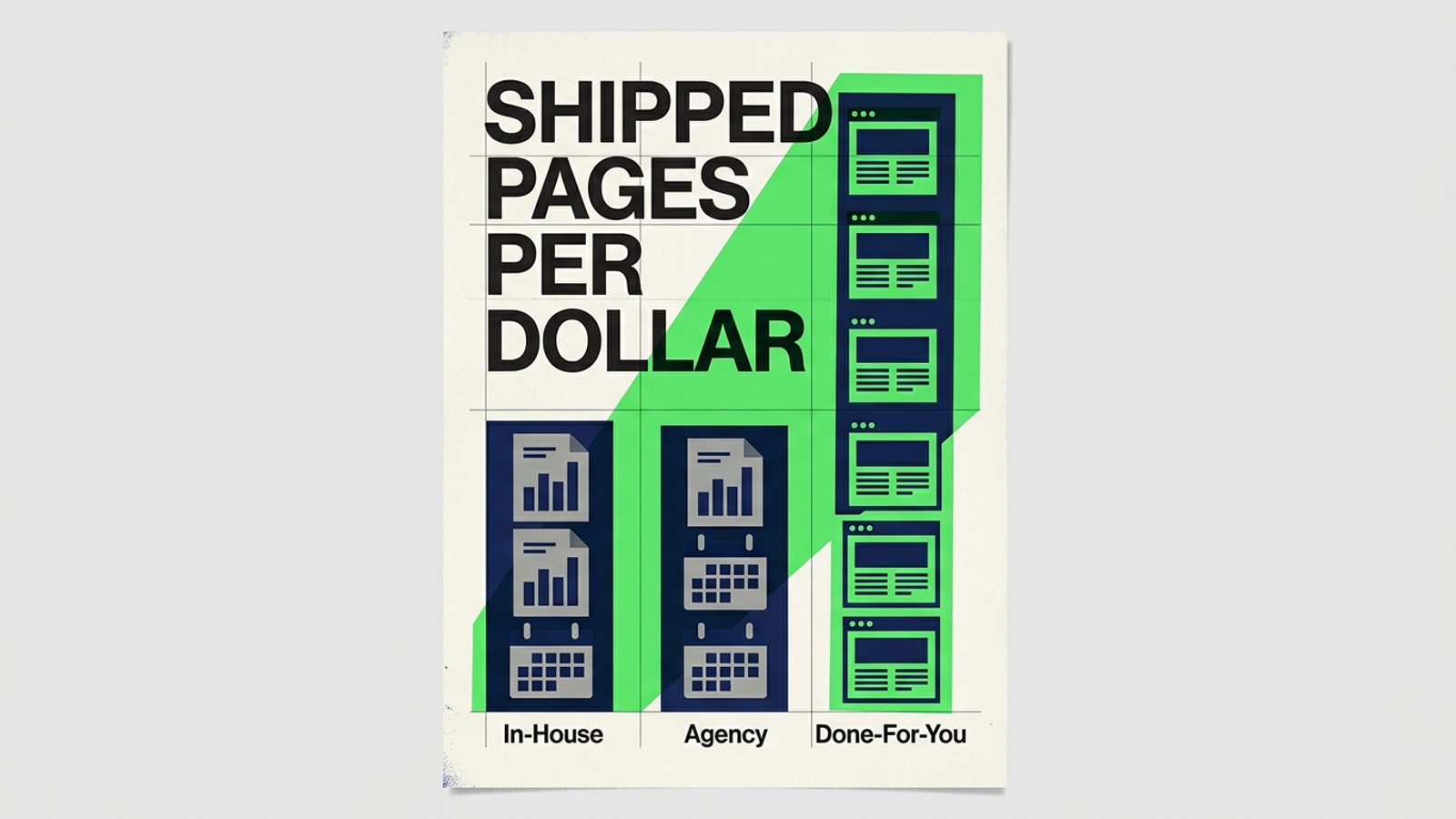
For the small or mid-sized owner this comparison is written for, done-for-you wins. You do not have a spare marketer to feed a tracker, a developer waiting for schema tickets, or calendar space to turn every audit into a project. You need work shipped while you run the business, a strategist answerable for direction, and a record you can inspect. That is a better purchase than paying for awareness or for a plan that quietly assigns the execution back to you.
Count shipped changes next time someone pitches you. Ask for the prompt list, the engine-by-engine citation picture, and the pages and fixes that went live. The cheapest mistake is buying another tracker because the first chart did not move. The most expensive is paying month after month for awareness while the work stays undone. Whoever can put accountable execution in writing gets my money. Everyone else is selling you a mirror and calling it a workout.